RBI Opens M&A Financing:
What
the Numbers Actually Say
After 70 years of prohibition, Indian
banks can now fund corporate acquisitions. Here's a data-first breakdown of the
rules, the market size, and what it means for dealmakers.
Effective Date:
April 1, 2026 · Framework: RBI Capital Market Exposure
Directions, 2026
|
₹5L Cr Estimated lending opportunity unlocked |
70 yrs Duration of the prior prohibition |
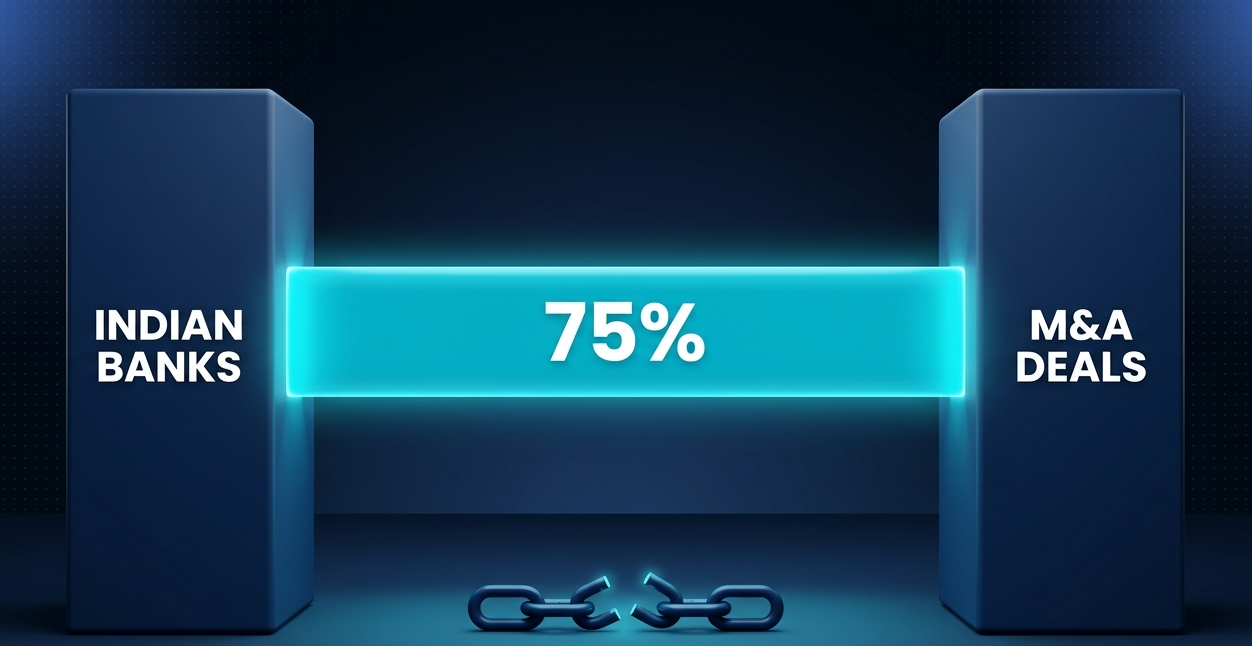
75% Max bank financing of deal value |
20% Cap on Tier-1 capital per bank |
The Rule Change, Precisely
On February 13,
2026, the RBI issued final Amendment Directions under its Capital Market
Exposure framework, effective April 1, 2026. The rules doubled the acquisition
finance cap from the initially proposed 10% to 20% of a bank's Tier-1 capital —
after banks collectively pushed back during the consultation period.
|
PARAMETER |
FINAL
RULE (FEB 2026) |
|
Max bank
financing per deal |
75% of
acquisition value |
|
Min promoter
contribution |
25%
equity, own funds |
|
Acquisition
finance cap per bank |
20% of
Tier-1 capital |
|
Total direct
capital market exposure |
40% of
Tier-1 capital |
|
Borrower
eligibility |
Min ₹500
Cr net worth, 3 yrs profitable, listed |
|
Max
debt-equity of acquirer |
3:1 |
|
Valuation
requirement |
2
independent valuations mandatory |
|
Scope |
Non-financial
entities only; PSU disinvestment allowed |
How Big Is India's M&A Market Right Now?
The policy arrived at a moment
when Indian dealmaking is already accelerating sharply.
|
$157.9B Total deal value, India 2025 Source: LSEG |
$26B M&A value, Jan–Sep 2025 649 transactions · EY India |
+37% YoY growth in M&A value, 2025 vs +10% globally |
+66% India deal surge vs Asia-Pacific APAC declined 5% same period |
Sector-wise in 2025, industrials
led with $35.4B (+221% YoY), followed by energy & power at $28.9B (+190%),
financials at $27B (+152%), and high technology at $19.9B (+100%).
|
Industrials $35.4B +221% YoY |
Energy & Power $28.9B +190% YoY |
|
Financials $27.0B +152% YoY |
High Technology $19.9B +100% YoY |
What Was Broken Before
Indian banks
were categorically banned from financing acquisitions since the 1950s. The
logic: acquisitions involve ownership transfer, not asset creation. Banks were
expected to fund capex and working capital not help one company buy another.
This created a structural gap.
|
Companies needing acquisition capital had to route deals
through NBFCs, foreign banks, or PE firms
all significantly more expensive than domestic bank credit. Management
buyouts (MBOs) and leveraged buyouts (LBOs) were structurally impossible for
most Indian corporates without expensive offshore structures. |
The SBI
chairman in August 2025 publicly said the Indian Banks Association would
formally petition the RBI for this change — a signal of how deep the demand was
within the system. Two months later, the RBI announced the framework.
Timeline of the Reform
▸
OCT 1, 2025 RBI Governor Sanjay Malhotra announces enabling framework for
bank M&A financing in MPC statement.
▸
OCT 24, 2025 Draft RBI (Commercial Banks – Capital Market Exposure)
Directions released for public consultation; proposes 70% deal financing, 10%
Tier-1 cap.
▸
NOV 21, 2025 Deadline for stakeholder comments; banks push for higher Tier-1
cap.
▸
FEB 13, 2026 Final Amendment Directions issued: cap raised to 20% Tier-1,
deal financing to 75%, ₹500 Cr net worth requirement added.
▸
APR 1, 2026 Rules come into force. Banks begin building internal acquisition
finance policies.
What It Means for PE & VC Exits
This is
arguably the highest-impact downstream effect. PE and VC firms in India have
consistently faced a structural problem: finding domestic buyers with cheap
financing. Without bank-backed acquisition loans, buyers relied on expensive
private credit, suppressing bid values and slowing exit timelines.
With banks now
able to finance up to 75% of a deal, a buyer acquiring a ₹1,000 Cr company
needs to bring only ₹250 Cr in equity — the rest can come from a syndicated
bank facility. This directly improves deal economics for both sides and expands
the buyer pool beyond large conglomerates.
|
The 50+
circulars governing capital market exposure since 1986 have been consolidated
and repealed under the new framework — replacing decades of patchwork
regulation with a single unified set of directions. |
The Risk the RBI Is Managing
Experts have
flagged two concerns. First, asset-liability mismatch: acquisition loans tend
to be long-duration (5–7 years) while bank funding is typically shorter.
Second, concentration risk if multiple large deals sour simultaneously.
The 20% Tier-1
cap, the 25% promoter contribution floor, the 3:1 debt-equity limit, and the
requirement for two independent valuations are all explicitly designed to
prevent the balance-sheet stress seen in infrastructure loan cycles. The
restriction to non-financial entities and profitability requirements further
narrow the eligible pool to the more creditworthy end of the market.
Sources
RBI Amendment Directions (Feb 13, 2026) · EY
India Dealtracker Q3 2025 · LSEG Deals Intelligence 2025 ·
Business Standard · Grant Thornton Bharat Dealtracker ·
AngelOne Research · Lexology / AZB & Partners ·
S&R Associates
M&A Advisory Services - for structuring acquisition financing within the RBI's Tier-1 cap, promoter contribution floor, and debt-equity limits covered in this report.