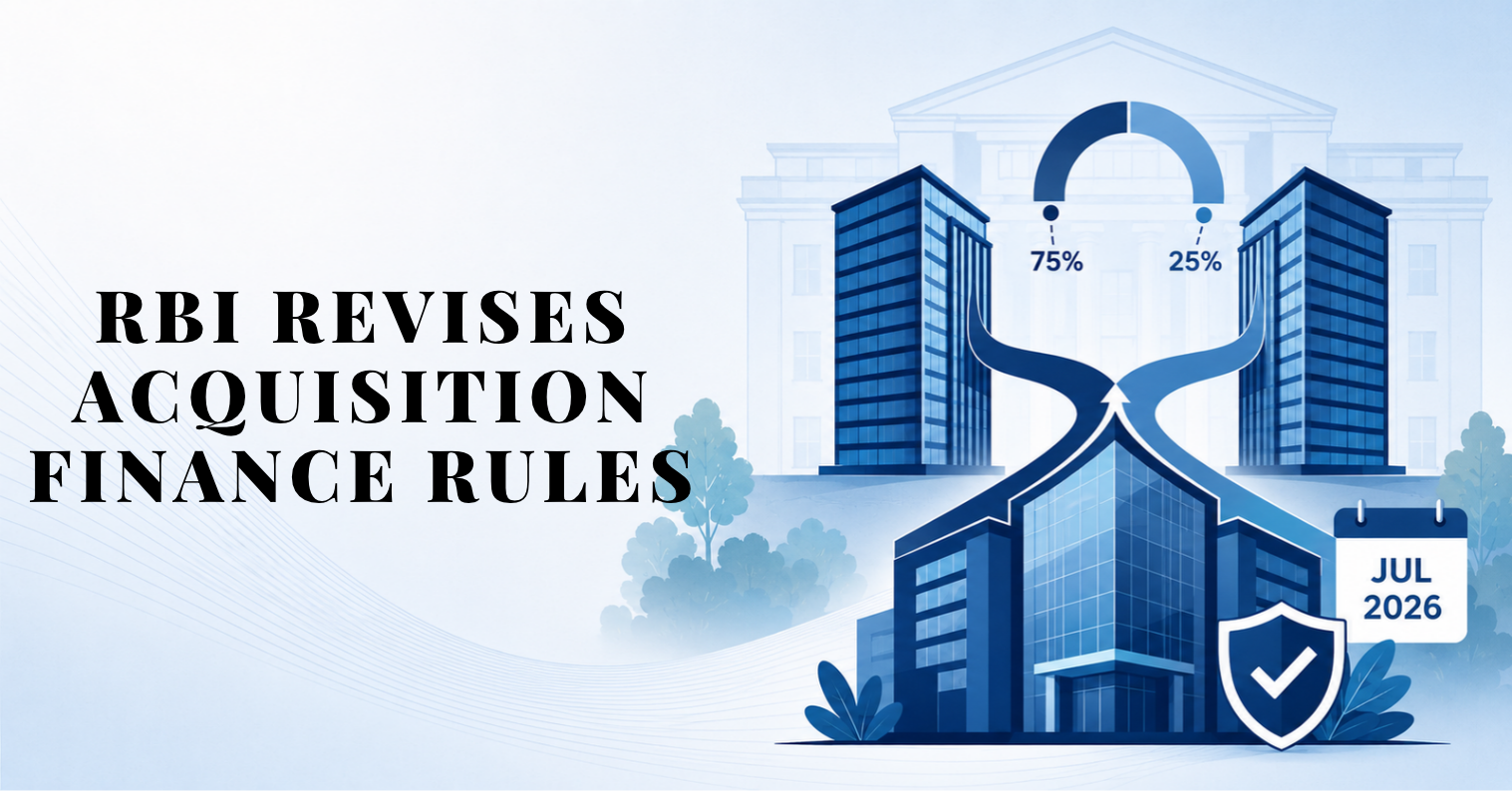
Quick answer: The Reserve Bank of India's (RBI) acquisition finance directions have been revised, effective 1 July 2026. The core structure holds: banks can fund up to 75% of an acquisition, acquirers need a genuine own-funds contribution, and control must follow a fixed timeline. The revision clarifies the definition of acquisition finance, tightens the 12-month control window, sets out what counts as own funds, and lays out conditions for refinancing acquisition debt.
In an earlier report, we covered RBI's original decision to let banks finance corporate acquisitions and what that could mean for India's M&A market. That framework has now been revised, bringing more clarity to how acquisition finance can be structured, deployed and refinanced. The core rules are unchanged, including the 75% bank-financing ceiling, the financial eligibility bar and the leverage safeguards. The revised directions settle several practical questions that acquirers and their advisors were working around.
The revised directions took effect on 1 July 2026. Companies weighing an acquisition should build financing timelines, security structuring and refinancing plans around these rules from the term sheet stage, not bolt them on afterward.
What's New in RBI's Revised Acquisition Finance Framework
The revision sharpens five areas: the definition of acquisition finance, the timeline for acquiring control and the acquirer's own contribution. It also covers refinancing, the use of subsidiaries or specified SPVs, and the safeguards attached to each.
A Broader Definition of Acquisition Finance
The revised framework defines acquisition finance around the acquisition of control of a target company. Control can be acquired through equity shares, compulsorily convertible preference shares or compulsorily convertible debentures, and the definition now expressly covers acquisitions carried out through amalgamation or merger.
This matters because M&A deals rarely follow one template. Depending on the transaction, control can come through several different routes, and the revised framework now recognises more of them. The focus, though, stays on strategic investment by eligible non-financial companies, not on acquisitions structured purely for short-term financial restructuring.
The 12-Month Control Timeline
One of the more practical changes concerns how long an acquirer has to establish control. Under the revised rules, control must be acquired within 12 months of the first disbursement of acquisition finance.
Treat the financing timeline as a design input for the deal itself. Sequence the acquisition agreement, financing arrangements and completion mechanics together so control lands inside the 12-month window.
The 25% Own Funds Requirement
Banks can finance up to 75% of the acquisition value, subject to the applicable conditions. The remaining 25% has to come from the acquirer's own funds, and the revised framework spells out what qualifies.
- Internal accruals
- Proceeds from asset sales
- Redemption of investments
- Fresh equity
- Borrowings
- Fixed-repayment instruments
- Certain intragroup funding sourced from borrowing
The principle behind this is straightforward: the acquirer needs real capital at risk in the deal. The 25% contribution cannot be manufactured by stacking another layer of debt underneath it.
Refinancing Is Permitted, With Conditions
Banks can now refinance existing acquisition debt, but the flexibility comes with limits. Refinancing can only happen once the acquisition finance has been concluded in full and control over the target is established.
Refinancing cannot be used to repay the acquirer's own contribution, or for anything other than retiring the original acquisition finance debt.
More Structuring Flexibility, Within Defined Safeguards
The revised framework allows acquisition finance to flow through the acquirer itself, through certain non-financial subsidiaries, or through specifically established step-down SPVs. Where finance is extended to a subsidiary or SPV, a corporate guarantee from the acquiring company is required.
- A consolidated Debt-to-Equity ratio of no more than 3:1 after the acquisition
- Debt claims of the acquirer or its group against the target must stay subordinate to the bank's acquisition finance claims for the full tenor of the facility
- Acquisition finance cannot be extended where the non-financial target has one or more financial entities as subsidiaries or joint ventures
Why the ₹500 Crore Net Worth Threshold Matters
RBI has set a minimum net worth threshold of ₹500 Cr for companies seeking acquisition finance, a cautious starting point for opening bank funding to M&A. It works as an eligibility filter on the acquiring company, a way of making sure that whoever accesses this route has a certain level of financial strength behind them.
This does not shut smaller corporates out of doing acquisitions. It means they cannot use this specific bank-financed route unless they clear the eligibility bar. The signal from RBI is that bank-financed M&A is opening up, but starting with companies that have stronger balance sheets and more capacity to manage acquisition-related debt.
What This Means for Dealmakers
The revised framework does more than add a funding source for acquisitions. It changes what needs to be true before a bank-financed deal can get off the ground. Bank financing can now cover a real share of the acquisition value for eligible transactions, giving corporates another route to fund strategic acquisitions.
At the same time, the framework makes leverage conditional on genuine acquirer contribution, financial strength, adequate security and a clearly defined path to control. It is built to balance financing flexibility against the discipline that should sit underneath any leveraged transaction.
The question is no longer just how much debt a deal can carry. It is whether the transaction has been structured to be financeable under the revised RBI framework from day one, not retrofitted once financing is already in motion.
FAQs on RBI's Acquisition Finance Rules 2026
What Is Acquisition Finance Under RBI's Revised Directions?
Acquisition finance is bank funding provided to an eligible non-financial company to acquire control of a target company. Control can be acquired through equity shares, compulsorily convertible preference shares, compulsorily convertible debentures, or through a merger or amalgamation.
How Much of an Acquisition Can Indian Banks Finance?
Banks can finance up to 75% of the acquisition value, subject to the eligibility and safeguard conditions in the revised directions. The remaining 25% must come from the acquirer's own funds.
What Counts as Own Funds for Acquisition Finance?
Internal accruals, proceeds from asset sales, redemption of investments and fresh equity qualify. Borrowings, fixed-repayment instruments and certain intragroup funding sourced from borrowing do not.
Can Acquisition Finance Be Refinanced?
Yes, but only after the original acquisition finance has been concluded in full and control over the target has been established. Refinancing cannot be used to repay the acquirer's own contribution.
Which Companies Are Eligible for RBI-Regulated Acquisition Finance?
Acquiring companies need a minimum net worth of ₹500 Cr, along with the other financial eligibility conditions set out in the framework. Acquisition finance is not available where the non-financial target has financial entities as subsidiaries or joint ventures.
When Did the Revised Acquisition Finance Rules Take Effect?
The revised directions took effect on 1 July 2026.
- Acquisition finance now covers equity, compulsorily convertible instruments and merger or amalgamation routes, not just straight share purchases.
- Control must be established within 12 months of first disbursement, so the deal timeline needs to be built around this window from the term sheet stage.
- The acquirer's 25% own contribution must come from genuine sources such as internal accruals or fresh equity, not fresh borrowing.
- Refinancing is only available once the original acquisition finance is fully concluded and control is established.
- A ₹500 Cr net worth threshold sets the eligibility bar for this route, not a ceiling on which companies can pursue M&A.
This report builds on our earlier coverage of RBI's original decision to permit bank-financed acquisitions. For a structured read on how the revised framework affects your acquisition timeline, own-funds planning or refinancing strategy, Dev Mantra's M&A Advisory team can walk through the details.