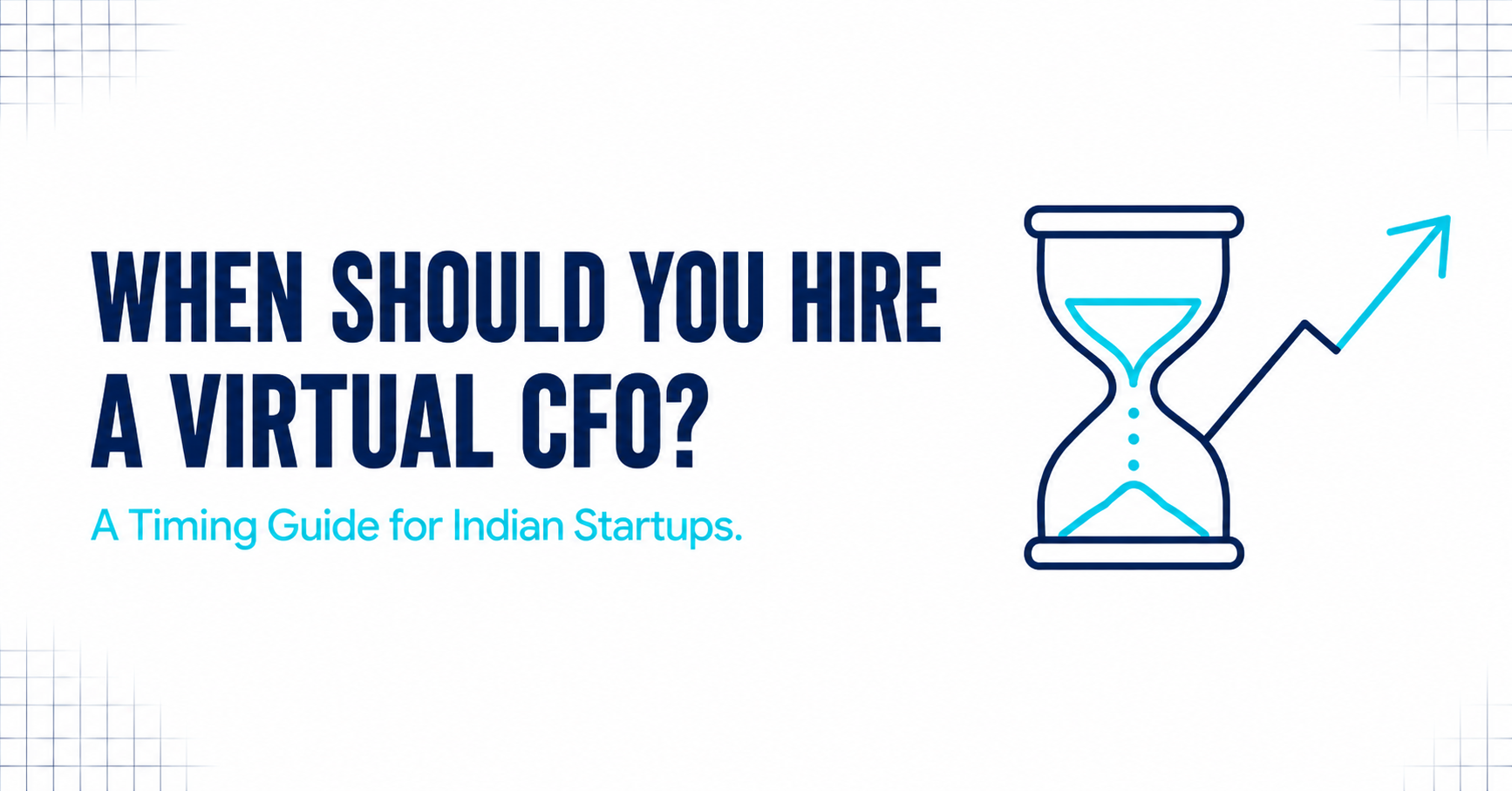
Most founders don't ask whether they need a virtual CFO. They ask it too late — usually between a term sheet that stalls on financial diligence and a GST notice nobody flagged in time. The real question is timing, not need.
Why Timing Beats the Hiring Decision
Every founder eventually agrees, in principle, that financial leadership matters. The disagreement is always about when. Hire too early, and you pay senior strategic fees for a business that only needs someone to close the books on time. Hire too late, and you rebuild two years of financial history mid-negotiation, while an investor's diligence team asks questions nobody on your team can answer cleanly.
Both mistakes are expensive, and neither is obvious until it happens. That's why timing deserves more attention than the hiring decision itself.
Stage-Based Signals from Pre-Seed to Series A
At pre-seed, most startups don't need a CFO of any kind. A competent bookkeeper and a chartered accountant who files GST and TDS returns on schedule cover it. The finance function at this stage is transactional: record what happened, pay what's owed, file what's due.
The shift usually starts between seed and Series A. Revenue lines multiply, and the company opens a second bank account, sometimes a third. Payroll grows past the point where a spreadsheet is a safe system of record. Founders raising a seed extension or preparing for Series A start needing monthly MIS packs, runway models, and unit economics that hold up under investor scrutiny.
In our advisory work, the pattern is consistent. Once monthly burn crosses roughly ₹15-20 lakh, or a business runs three or more distinct revenue streams, the finance function has outgrown what a single accountant can own alone. By Series A, the question isn't whether financial leadership is needed — it's whether the startup can afford to operate without it for another quarter.
The Fundraising Signal Comes Before the Term Sheet
If there's one signal founders consistently misread, it's this one. Most assume a virtual CFO becomes useful once a fundraising round is underway. In practice, the value shows up earlier — in the six to nine months before the first serious investor conversation.
A clean data room doesn't assemble itself in the two weeks after a term sheet lands. Cap table hygiene, ESOP pool documentation, and revenue recognition that matches accounting standards rather than founder intuition all need to be in order before diligence begins. FEMA filings for any foreign investment already on the books, Form FC-GPR among them, follow the same rule. A startup actively fundraising, or expecting to raise within the next two quarters, has already crossed the line where a virtual CFO earns its fee many times over.
The Founder Time-Drain Signal
Ask any founder how much of their week goes to finance, and most underestimate it badly. Reconciling invoices, chasing vendor payments, building the investor update deck, and checking whether GST was actually filed this month — it adds up fast. Once that work crosses 20% of a working week, roughly one full day, it carries a real cost. That's time not spent on product, customers, or hiring, the three things only a founder can actually own.
Track your own week for ten working days. If financial admin eats more than a day each week, that's the clearest signal to start virtual CFO conversations now.
The Compliance Complexity Trigger
Indian regulatory compliance for startups rarely stays simple for long. A single-entity, single-state business can, within a year, be dealing with GST registrations across multiple states and RBI reporting on external commercial borrowings or FDI inflows. It may also face the full statutory calendar under the Companies Act, 2013, from board minutes to annual ROC filings. Each requirement is manageable alone; stacked together, they need someone actively managing risk, not just meeting deadlines.
When FEMA and RBI reporting requirements enter the picture — cross-border transactions, ECBs, or FDI inflows — that's usually the clearest signal the finance function needs oversight beyond routine bookkeeping.
The Team-Growth Signal
Headcount is a lagging indicator, but still a useful one. Somewhere around 25 to 30 employees, payroll complexity increases — multiple pay bands, statutory PF and ESI contributions, and possibly the first international hire. The business typically starts running more than one cost centre at this size.
Finance then stops being a single function and starts needing real structure. That means budgets by department, clear approval workflows, and someone who can say what should be spent next quarter, not just what already was.
A Practical Self-Assessment for Founders
Rather than guessing, run through these five questions honestly.
- Are you spending more than a day a week on financial tasks that don't need your specific judgment?
- Have you already raised a round, or do you expect to close investor conversations within two quarters?
- Does your business have any cross-border transaction, RBI reporting obligation, or FEMA filing requirement?
- Has your team grown past 25 to 30 people, or added a second meaningful revenue line?
- Could your team produce an accurate MIS this week without a scramble, if a lender asked?
Two or more "yes" answers is a reasonable signal. The decision is no longer premature — it has become due.
What Happens When Timing Goes Wrong
Hiring too early has a quiet cost. A pre-seed startup with a few crore in the bank and one revenue line doesn't need a senior virtual CFO advising on IPO readiness or M&A structuring. It needs disciplined bookkeeping and a founder who reads the numbers weekly. Bringing in senior financial leadership before the business has the complexity to use it means paying for seniority that sits underused.
Hiring too late is the costlier mistake. It shows up as restated financials mid-raise, due diligence that drags for months, or a FEMA compliance gap that RBI flags first. Investors notice when a startup's finance function looks improvised, and it can affect whether the round closes at all.
Virtual CFO engagements in India typically run ₹40,000 to ₹1.5 lakh a month, depending on scope and stage — a fraction of what either mistake tends to cost. That's the extent of the pricing detail worth covering here; the timing decision matters more than the fee.
When Is the Right Time to Hire
Most Indian startups reach the right moment when they move from seed to Series A, or enter active fundraising conversations. It also arrives when the founder spends more than 20% of the week on invoicing, reconciliation, and investor reporting.
What Revenue Signals Point to Hiring
There's no fixed revenue threshold, but most Indian startups find a virtual CFO worthwhile once monthly revenue crosses roughly ₹15-25 lakh. It's also a signal once the business runs across multiple states, currencies, or revenue lines a single bookkeeper can no longer track.
Can You Hire Before Raising Funds
Yes, and many founders find this the most effective timing. A virtual CFO can build clean financial statements, a defensible valuation model, and audit-ready records well before a term sheet arrives. That shortens due diligence and lowers the risk of a deal-slowing surprise.
Too Early vs Too Late Hiring
Hiring too early means paying for senior financial strategy the business doesn't yet have the complexity to use. Hiring too late means entering fundraising, audits, or FEMA and RBI reviews without the financial infrastructure to withstand scrutiny. Both outcomes end up costing more than the virtual CFO's fee would have.
Do You Still Need an Accountant
Yes, in most cases. An accountant or bookkeeper records transactions accurately, while a virtual CFO interprets that data for cash flow forecasting, fundraising strategy, and board-level decisions. Growing startups typically need both functions rather than one replacing the other.
The founders who get this right don't wait for a crisis to force the decision. They treat a virtual CFO hire as a decision made slightly ahead of the need, not in response to it.
- Track your founder week — a full day spent on financial admin is the clearest hiring trigger.
- Watch for ₹15-20 lakh in monthly burn or three or more revenue streams as the point a single accountant stops being enough.
- Start virtual CFO conversations six to nine months before your first serious investor meeting, not after a term sheet lands.
- FEMA, RBI, and cross-border compliance requirements signal you need oversight beyond routine bookkeeping.
- Treat two or more "yes" answers on the self-assessment as proof the decision is already due.
The next founder conversation about financial leadership doesn't have to start during a due-diligence fire drill. Ask the timing question early, before a lender, an investor, or a compliance deadline forces it. That habit is what separates founders who scale calmly from those who scale in crisis mode.