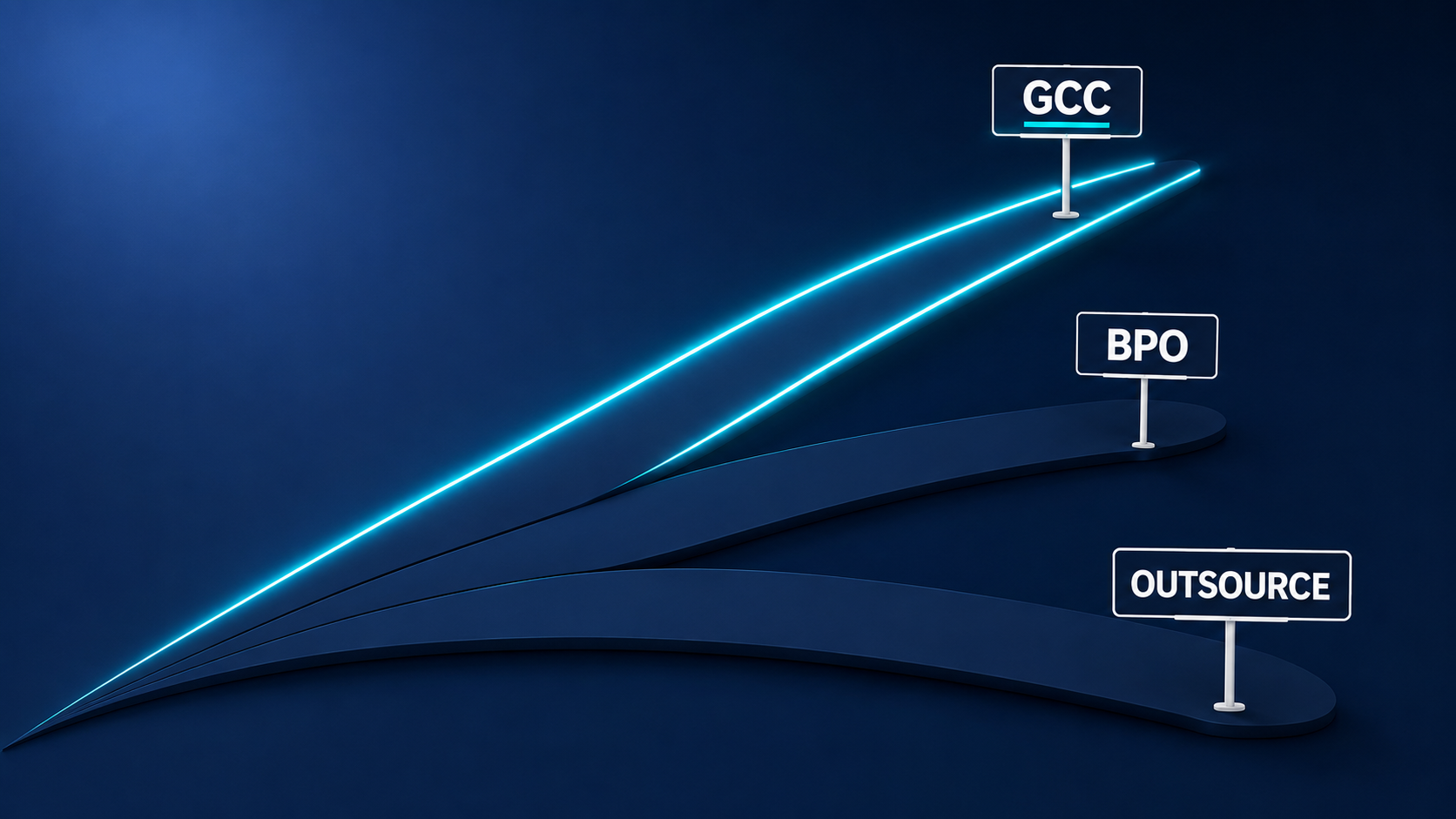
Most companies entering India for the first time are asking the wrong question. They ask: should we outsource, or should we offshore? The right question is: what kind of ownership do we want over this capability five years from now?
That single shift in framing changes everything. The answer to the ownership question determines which operating model you should build - and getting that choice wrong in Year 1 is expensive to fix in Year 3.
India now offers more operating model options than any other offshore destination in the world. The problem isn't a lack of options. The problem is that most companies choose a model based on who they spoke to last - a BOT provider pitching BOT, an outsourcing vendor pitching outsourcing - rather than on a clear-eyed analysis of what the business actually needs.
This guide gives you that analysis. Three models. Their real costs. The IP implications most advisors don't discuss. And a decision framework that doesn't require you to take anyone's word for it.
The Three Models, Without the Jargon
GCC / Captive Center
A Global Capability Center is a wholly-owned subsidiary of the foreign parent. The employees are direct hires. The IP they create belongs to the parent. The entity sits on Indian soil, operates under Indian law, and works exclusively for the group.
It is the highest-control, highest-commitment model. Everything that goes right is yours. Everything that goes wrong is also yours.
BPO (Business Process Outsourcing)
A BPO is a contract with a third-party vendor. The vendor employs the staff, manages the operations, and delivers outputs under a Service Level Agreement. You pay for the service. You don't own the operation.
The vendor retains operational control. Unless your contract explicitly states otherwise, the vendor also retains background IP - the processes, methods, and accumulated knowledge embedded in how the work is done.
Outsourcing / Offshore Managed Teams
The broader category. Covers project-based SOW engagements, offshore managed teams, and hybrid arrangements. Ownership depends entirely on the contract. IP transfer requires explicit "work made for hire" or assignment language - which many contracts lack.
The Analogy That Makes It Stick
Think of it as a food business.
With a BPO, you call a catering company. They bring the kitchen, the staff, the recipes. You get the food delivered. The moment you stop paying, the kitchen goes with them.
With outsourcing, you hire a chef on project terms. The recipes might be yours if you negotiated it right. The relationship ends when the project does.
With a GCC, you own a kitchen in another city. The staff are your employees. The recipes are your IP. Every year of operation builds institutional knowledge you keep. You are building an asset, not renting a service.
The BPO looks cheaper on Day 1. The captive looks cheaper by Year 3. The math changes - and we'll show you exactly where the crossover happens.
The IP Question Most Advisors Skip
In 2020, the question of IP ownership in India operations was largely theoretical. In 2026, it isn't.
The strategic work being done in Indian GCCs today is not back-office processing. It's AI model training, proprietary data pipelines, product engineering, financial risk models, and compliance technology. These are not commodity services. They are the foundational IP of businesses.
Under a BPO arrangement
- Background IP - the vendor's existing methods, tools, and processes - stays with the vendor
- Foreground IP, the work product created during the engagement, goes to the client only if the MSA says so explicitly
- In practice, many MSAs have ambiguous IP clauses, and disputes arise at the point of vendor transition
Under a GCC
- All IP created by Indian employees vests in the Indian subsidiary
- It is then assigned to the parent via an Inter-Company Service Agreement at arm's-length pricing
- There is no dispute about who owns what. It's yours.
When your India team trains a model, fine-tunes an LLM on your proprietary data, or builds a machine learning pipeline that becomes core to your product - who owns that? If you're in a BPO relationship, read your contract carefully before you answer. If you're in a captive, the answer is unambiguous.
The Real Cost Comparison: 100 FTE Over 5 Years
This is the comparison most advisory firms won't publish because it makes the BPO look worse than the sales process suggests. Numbers are 5-year total cost of ownership for a 100-FTE operation, in USD.
| Model | Y1 Setup | Annual Run-Rate (Y2–5) | 5-Yr TCO | Savings vs Onshore |
|---|---|---|---|---|
| Captive GCC (DIY) | $0.5–1.5M | $5–7M | $26.5–39.5M | 40–60% |
| BOT → Captive | $0.2–0.5M | $5.5–7.5M | $28.2–38.5M | 35–55% |
| BPO | ~$0 | $6–9M | $30.1–45.5M | 25–45% |
| Pure outsourcing | ~$0 | $6–10M | $30–50.5M | 20–40% |
| US/UK equivalent | - | $8–12M | $40–60M | - |
The BPO looks attractive at Year 1 - no setup capex, no entity overhead, operational from Week 2. By Year 3, the vendor margin (typically 10–20% of billable cost) has compounded. By Year 5, the captive has usually crossed the break-even point and continues to widen the cost advantage as scale grows.
The other number most models miss: switching costs. When a BPO contract ends or underperforms, transitioning to a new vendor - or to a captive - involves knowledge transfer, re-documentation, re-hiring, and productivity loss. Conservative estimates put BPO-to-captive transition costs at $500K–2M for a 100-person operation. That cost rarely appears in the BPO business case.
The Hidden Costs of Each Model
Numbers that don't appear in brochures - but will appear on your P&L.
Captive GCC
- GCC Head salary: ₹1.5–4.5 crore annually. Non-negotiable for a serious operation.
- Annual compliance overhead - TP documentation, FEMA filings, DPDP, statutory audit - runs $30,000–80,000 per year
- 18-month productivity ramp as new hires learn the business context
- Attrition of 16–22% in Tier-1 cities, with constant backfill cost
BPO
- Vendor margin of 10–20% of total billable cost, every year
- SLA lock-in: commercial penalties for scope changes, making the relationship sticky in ways that hurt when the business evolves
- Talent poaching risk: your dedicated BPO team is visible to other clients of the same vendor, and high performers get moved
- Renewal negotiation every 3–5 years, when vendors know your switching cost is high
Outsourcing / Managed Teams
- SOW scope creep: every requirement change is a change order
- Knowledge loss at vendor transitions, as proprietary context walks out the door
- Re-tendering costs every engagement cycle
Why the 2026 Balance Favours Captives
Three developments in 2026 specifically favour the captive over outsourcing arrangements, in ways that weren't true three years ago.
Transfer pricing is now simpler than BPO billing. Budget 2026's 15.5% safe harbour election means a GCC can declare a clean profit margin and avoid TP scrutiny for 5 years. BPO billing arrangements - where the vendor invoices the client and the client invoices internal stakeholders - create multiple tax touchpoints. The captive now has a structural tax simplicity advantage.
DPDP creates a data governance complexity gap. Under India's Digital Personal Data Protection Rules, notified in November 2025, a GCC is a Data Fiduciary - it owns the data governance obligation directly. A BPO arrangement creates a sub-processor relationship with shared obligations and unclear accountability for cross-border transfers. For companies processing sensitive employee or customer data, the captive is a cleaner compliance structure.
State incentives don't reach BPO arrangements. Karnataka's GCC Policy offers 50% rental reimbursement for Tier-2 locations, R&D grants up to ₹50 crore, EPF reimbursements, and a 45-day approval track. Maharashtra, Telangana, and UP have similar frameworks. These incentives apply to captive entities. A BPO vendor captures them internally - they don't pass through to the client.
The Decision Framework: Which Model for Whom
Use this to cut through the noise.
Choose a Captive GCC if
- You are planning 200+ FTE over 3–5 years
- The function is IP-creating - engineering, AI, product, financial modelling
- You have, or can hire, experienced India leadership to run it
- You are willing to invest 12–18 months of setup time for 5–10 years of compounding advantage
Choose a BOT if
- You are entering India for the first time with 50–500 FTE
- You don't have India operational expertise internally
- You want full IP ownership eventually but need speed and risk reduction upfront
- You are willing to pay a 10–25% partner margin during the build phase
Choose a Micro GCC or GCC-as-a-Service if
- You are building a focused, narrow-mandate team of 15–80 people
- You want captive ownership economics without the full DIY overhead
- You need to be operational in 4–8 weeks, not 16
Choose EOR if
- You are running a pilot under 25 people
- You need to move in days, not weeks
- You understand this is a temporary structure, not a permanent operating model
Choose a BPO if
- Your work is high-volume, standardised transactional processing - claims, document processing, call centre
- It is short-term or project-based work with no accumulating IP value
- It is a function where vendor economies of scale genuinely reduce cost below what a 20-person captive could achieve
There are legitimate uses for BPO. The mistake is using it for strategic, IP-generating work that belongs in a captive. Match the model to the nature of the work - not to the slide deck of the last vendor you met.
Four Questions Before You Decide
Before committing to any model, four questions are worth answering honestly.
What happens to this function in five years? If the answer is "it becomes core to how we compete," the captive economics make sense even if the upfront cost is higher. If the answer is "it's a support function that could be standardised," a BPO may be appropriate.
Who owns the institutional knowledge? Every year of operation, your India team learns your business, your systems, your customers. In a captive, that knowledge stays with you. In a BPO, it stays with the vendor.
Can you absorb the compliance overhead? A captive requires active management of FEMA filings, transfer pricing, DPDP compliance, and Labour Code obligations. These are not optional and not trivial. If you don't have advisory support for this, the compliance gap becomes expensive quickly.
What does the 18-month picture look like? Both BPO transitions and captive setup projects have a productivity dip. Planning for it honestly is better than being surprised by it.
The right question isn't whether to outsource or offshore. It's what kind of ownership you want over this capability five years from now. Get the ownership question right, and the operating model answers itself.
- Frame the choice as an ownership question, not an outsourcing question - every other decision flows from this
- The cost crossover happens around Year 3: BPO is cheaper at Year 1, captive wins decisively by Year 5
- For IP-creating work - AI, engineering, product, financial modelling - captive ownership prevents the contract disputes that BPO arrangements routinely surface
- In 2026, transfer pricing simplification, DPDP, and state incentives all structurally favour captives over BPO arrangements
- Match the model to the work: BPO for high-volume standardised processing, captive or Micro GCC for strategic IP-generating capabilities
How Dev Mantra Helps
Choosing the wrong operating model in Year 1 is a recoverable mistake. It is also an expensive one - in transition costs, in compliance exposure, in IP disputes, and in the talent disruption of moving a team from one structure to another.
Dev Mantra Financial Services has been structuring India operations for global companies since 2008. The firm's work spans entity incorporation and FEMA compliance, transfer pricing architecture from Day 1, DPDP readiness, and ongoing CFO advisory as the operation scales.
The advice is not model-agnostic in the sense of being uncommitted. It is model-agnostic in the sense that the right structure depends on your business, not on which model generates the highest advisory fee. For most mid-market companies building strategic capabilities in India, a captive or Micro GCC is the right structure. We'll tell you when it isn't.
Talk to Dev Mantra's GCC advisory team.
NASSCOM-Zinnov India GCC Landscape Report (Sep 2024); Finance Act 2026; MeitY DPDP Rules notification (Nov 2025); ANSR GCC Compensation Report 2025; Karnataka GCC Policy 2024–29; Wisemonk GCC Setup Guide 2026; Everest Group GCC PEAK Matrix 2025.
How to Set Up a GCC in India in 2026 - costs, models, and the Micro GCC explained.
Micro GCC India 2026 - setup cost, paths, and timeline.