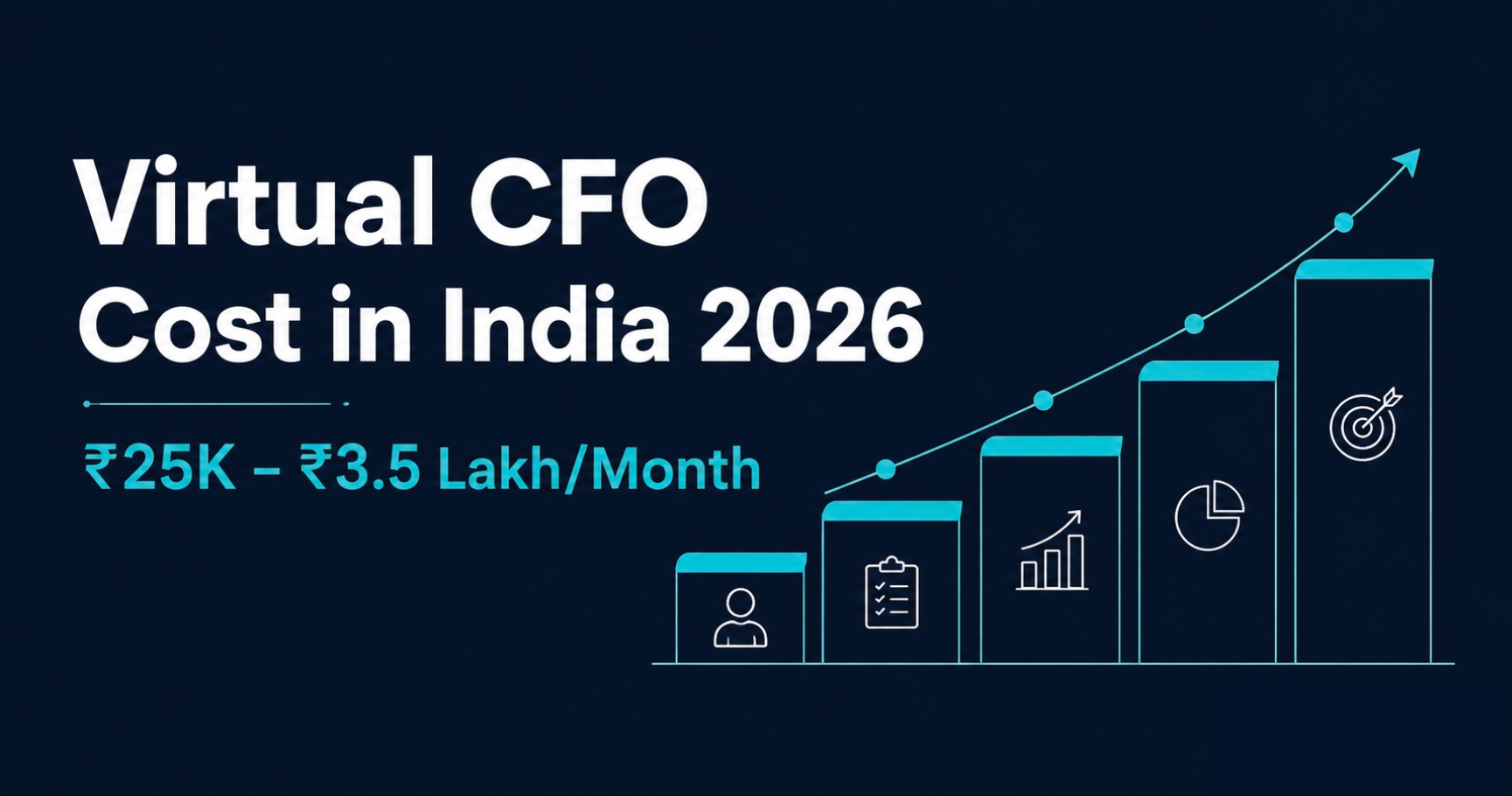
Every founder we speak to in Bengaluru eventually asks the same question — not "should I hire a Virtual CFO" but "what does it actually cost, and is the number in my head anywhere close to reality?" The honest answer: probably not. Virtual CFO pricing in India in 2026 spans from ₹25,000 a month for a pre-revenue company to ₹3.5 lakh and above for a Series B or GCC finance mandate. The right number depends on three things: your current revenue or funding stage, the scope of work you actually need, and whether the engagement is retainer-based, project-based, or somewhere in between.
Why VCFO Pricing Is So Opaque in India
Most Virtual CFO firms in India do not publish prices. The reason is partly commercial — scope varies significantly — and partly competitive, since no one wants to be compared on price alone. The result is that founders enter discovery calls with no anchor, and they either overpay because they do not know the market, or they underpay and end up with a bookkeeper holding a fancy title.
Firms such as Jordensky, Treelife, 21Degrees, and CFO Bridge have begun publishing indicative ranges. Combined with Dev Mantra Advisory's own engagement data across 150+ mandates, what follows is the clearest pricing picture available for 2026.
The Four Variables That Set Your VCFO Bill
1. Company stage and revenue
A pre-seed founder with ₹50 lakh ARR needs 8–10 hours of strategic finance support a month — cash flow visibility, a simple MIS, and compliance oversight. A Series A company at ₹20 crore ARR needs 20–30 hours: investor reporting, FP&A, monthly board decks, and fundraising prep. Same service category, completely different scope.
2. Scope of work
Standard retainers cover MIS, monthly P&L review, cash flow forecasting, compliance calendar oversight, and a monthly advisory call. Extended retainers add FP&A, investor reporting, financial model maintenance, treasury management, and board deck preparation. Project mandates — fundraise support, ERP implementation, M&A advisory — are always priced separately.
3. Experience level
A 3-year CA with some FP&A exposure is not equivalent to a partner-level CA with 15+ years and senior finance leadership experience. The ₹25,000/month end of the market is typically junior-to-mid CA execution. Above ₹1 lakh/month, you should be receiving partner-led, board-tested advisory.
4. Geography and client mix
Bengaluru and Mumbai firms with heavy startup and GCC exposure command a 15–25% premium over similar-depth providers in tier-2 cities. Cross-border mandates — India subsidiary of a US or UK parent — carry a further 25–30% premium due to dual-GAAP complexity.
Stage-Wise VCFO Pricing in India 2026
These are market-rate ranges, not floor prices. A firm with exceptional depth and named references will price at or above the upper end. A freshly established practice will price at the lower end to build a client base. You are not comparing like for like across that range.
Pre-revenue / Pre-seed — ₹15,000–₹40,000/month
6–10 hours a month. Covers basic cash flow tracking, compliance calendar management, and a monthly review call. USD equivalent: $180–$480.
Seed (post-round, less than ₹5 Cr ARR) — ₹35,000–₹75,000/month
10–15 hours a month. Adds MIS reporting, budget vs. actual tracking, KPI dashboards, and GST/TDS oversight. USD equivalent: $420–$900.
Series A prep / ₹5–15 Cr ARR — ₹75,000–₹1,50,000/month
15–25 hours a month. Includes MIS plus investor reporting, financial model maintenance, and board deck preparation. USD equivalent: $900–$1,800.
Series A / ₹15–30 Cr ARR — ₹1,25,000–₹1,75,000/month
22–28 hours a month. Covers full FP&A, treasury management, fundraise support, and finance team mentoring. USD equivalent: $1,500–$2,100.
Series B / ₹30–100 Cr revenue — ₹2,00,000–₹3,50,000/month
35–50 hours a month. Encompasses M&A preparation, pre-IPO readiness, full controllership, and risk governance. USD equivalent: $2,400–$4,200.
GCC India entity — ₹1,50,000–₹3,50,000/month
25–40 hours a month. Includes US GAAP / Ind AS reconciliation, transfer pricing documentation, FEMA compliance, and parent entity reporting. USD equivalent: $1,800–$4,200.
SME ₹10–25 Cr revenue — ₹45,000–₹90,000/month
12–18 hours a month. Covers MIS, bank liaison, working capital management, and compliance oversight. USD equivalent: $540–$1,080.
SME ₹25–75 Cr revenue — ₹90,000–₹1,75,000/month
18–30 hours a month. Adds FP&A, audit coordination, and cost structure analysis to the SME base scope. USD equivalent: $1,080–$2,100.
Project-Based VCFO Pricing (One-Time Mandates)
Retainers cover ongoing advisory. Many of the highest-value engagements are project mandates billed separately — scoped to a specific outcome rather than monthly hours.
- Fundraising support (model, data room, DD coordination, term-sheet review): ₹2–8 lakh flat + 0.5–1% success fee on capital raised.
- Financial model build (3-statement, 5-year, scenarios): ₹75,000–₹2.5 lakh depending on complexity.
- ERP implementation oversight (Zoho / Tally / NetSuite; 4–6 months): ₹4–15 lakh.
- M&A advisory — buy-side or sell-side: ₹10–40 lakh + 1–2% success fee.
- SME IPO readiness (NSE Emerge / BSE SME; 12–18 months): ₹15–75 lakh.
- Transfer pricing study (Form 3CEB, FAR analysis): ₹2.5–7.5 lakh.
- 90-day finance transformation (books cleanup, SOP build, controls framework): ₹3–10 lakh.
The Full-Time CFO Cost Comparison
A full-time CFO at a Series A startup in Bengaluru in 2026 costs — fully loaded — between ₹1.0 and ₹1.8 crore in Year 1. That figure includes base salary (₹55–80 lakh), variable pay (₹15–25 lakh), ESOP at ₹200 crore valuation (₹30–80 lakh annualised), PF and benefits (₹8–12 lakh), and executive search fees (₹15–25 lakh, amortised over 12 months).
A Virtual CFO at the same stage costs ₹15–21 lakh annually. The saving is not marginal — it is ₹80 lakh to ₹1.5 crore, which could fund two engineers, a full year's marketing budget, or extend runway by three to five months.
- ₹1.0–₹1.8 Cr fully loaded in Year 1
- 40+ hours/week of dedicated attention
- Mandatory for listed entities under Section 203
- Best fit at ₹100 Cr+ revenue or pre-IPO stage
- Brings investor-relations visibility and roadshow presence
- ₹15–21 lakh annually on retainer
- 22–28 hours/month of partner-led advisory
- Best fit from pre-seed through Series B
- Covers FP&A, treasury, fundraise, and board decks
- Frees capital for engineering, sales, or runway extension
The Number That Changes the Conversation
The question is no longer whether a Virtual CFO is viable. It is whether you are at a stage where the full-time hire produces a return that a Virtual CFO cannot. For most companies below ₹50 crore revenue, that threshold has not been reached.
When the VCFO Model Stops Making Sense
A full-time CFO hire becomes necessary when your finance function demands 40+ hours of senior attention every week, your company is listed or preparing to list on a main board exchange, or your regulatory mandate under Companies Act Section 203 requires a whole-time CFO as a Key Managerial Person.
The VCFO model fails when the engagement is underpowered relative to actual scope — a founder buying ₹30,000/month and expecting Series B deliverables. It also fails when the provider carries too many clients to give adequate attention, or when "virtual" means the advisor has never met your team, your auditors, or your bankers. Both risks are real. The first is a pricing problem. The second is a selection problem.
If any of the five questions below produces a vague answer, the pricing conversation is premature. Resolve scope and accountability in writing before signing — not after.
What to Ask Before You Sign
Before committing to any VCFO retainer, get clear written answers to the following five questions:
- Who specifically will lead my engagement — the named partner or an associate?
- What is the deliverable list for Month 1, Month 3, and Month 6?
- How many other clients does the partner-lead manage simultaneously?
- What is your response-time SLA for urgent queries?
- What is explicitly excluded from this retainer — filing, signing, bookkeeping?
Why CA-Led Firms Have a Structural Advantage
The Virtual CFO market divides broadly into two models: ex-corporate CFO consultants — former VP Finance or CFO of a listed or funded company — and CA-led advisory firms, where CAs deliver both statutory and strategic finance. Ex-corporate CFOs bring deep operational experience at scale. They are excellent for companies approaching ₹100 crore, preparing for an IPO, or navigating complex M&A.
CA-led firms offer something different for companies below that threshold: the compliance-to-strategy bridge without stitching multiple vendors. GST review, ROC filings, transfer pricing documentation, and investor MIS all come from one practice with one accountability structure and an ICAI disciplinary framework behind every certification. For Indian startups under ₹50 crore, GCC India entities, and overseas CPA firms seeking offshore finance delivery, the CA-led model is typically the better commercial and structural fit.
Scope is negotiable; hourly rate is not. Define exactly what you need, match that scope to a package, and price the package — do not ask for a blanket discount on a standard retainer.
Frequently Asked Questions
What is the average VCFO cost in India in 2026?
For a mid-stage funded startup (Seed to Series A), the market rate for a substantive VCFO retainer is ₹60,000–₹1,50,000 per month. Rates below ₹40,000 at this stage usually reflect junior delivery, not boutique pricing.
Is a Virtual CFO cheaper than a full-time CFO in India?
Yes, substantially. A full-time CFO at a Series A startup costs ₹1–1.8 crore fully loaded in Year 1. A comparable VCFO engagement runs ₹15–21 lakh annually. The saving is real, not accounting sleight of hand.
What is the difference between a project-based and retainer VCFO?
A retainer is a fixed monthly fee for ongoing advisory — MIS, reporting, calls, oversight. A project mandate is scoped to a specific outcome (fundraise, M&A, ERP, IPO prep) and billed separately, typically at ₹75,000–₹40 lakh depending on duration and complexity.
Should I pay more for a CA-led firm versus an independent ex-CFO?
It depends on your stage. Below ₹50 crore revenue, the CA-led firm typically provides better regulatory depth and fewer vendor dependencies. Above ₹100 crore with IPO or institutional M&A on the horizon, an ex-CFO with sector depth and an investor network adds more strategic leverage.
- Match your VCFO spend to your actual stage — underpowered engagements are the single most common cause of VCFO failure.
- Confirm in writing that partner-level delivery is what you are paying for, not associate execution under a partner's name.
- Price the scope, not the rate — define Month 1, Month 3, and Month 6 deliverables before signing any retainer.
- CA-led firms suit most companies below ₹50 crore; ex-CFO consultants suit companies approaching IPO or institutional M&A.
- Project mandates — fundraise support, ERP, M&A advisory — sit outside the retainer and must always be contracted separately.
The VCFO market in India has matured enough that pricing opacity is no longer an excuse for overpaying or under-buying. Use the stage-wise ranges in this guide as your anchor, run every prospective provider through the five questions above, and select on demonstrated delivery depth — not on who has the most polished onboarding deck. The firms that produce results are willing to put specific deliverables in writing before they take your first payment.
Virtual CFO Services - see how Dev Mantra prices and scopes VCFO engagements against the stage-wise ranges in this guide.