For years, building a Global Capability Center in India was a decision that only large companies could seriously make.
The calculus was straightforward: minimum viable headcount was 200+, setup capex ran into the millions, and compliance required a dedicated team. The timeline from decision to operational was measured in quarters, not weeks. For a $50–500M company with a specific function it wanted to own - an AI team, a finance operations centre, a dedicated audit support team - the full captive model was simply too heavy a lift.
So mid-market companies outsourced. They hired BPO vendors. They took on managed service arrangements. And they spent years paying vendor margins on work that was generating IP they didn't own, building institutional knowledge that walked out the door at every contract renewal.
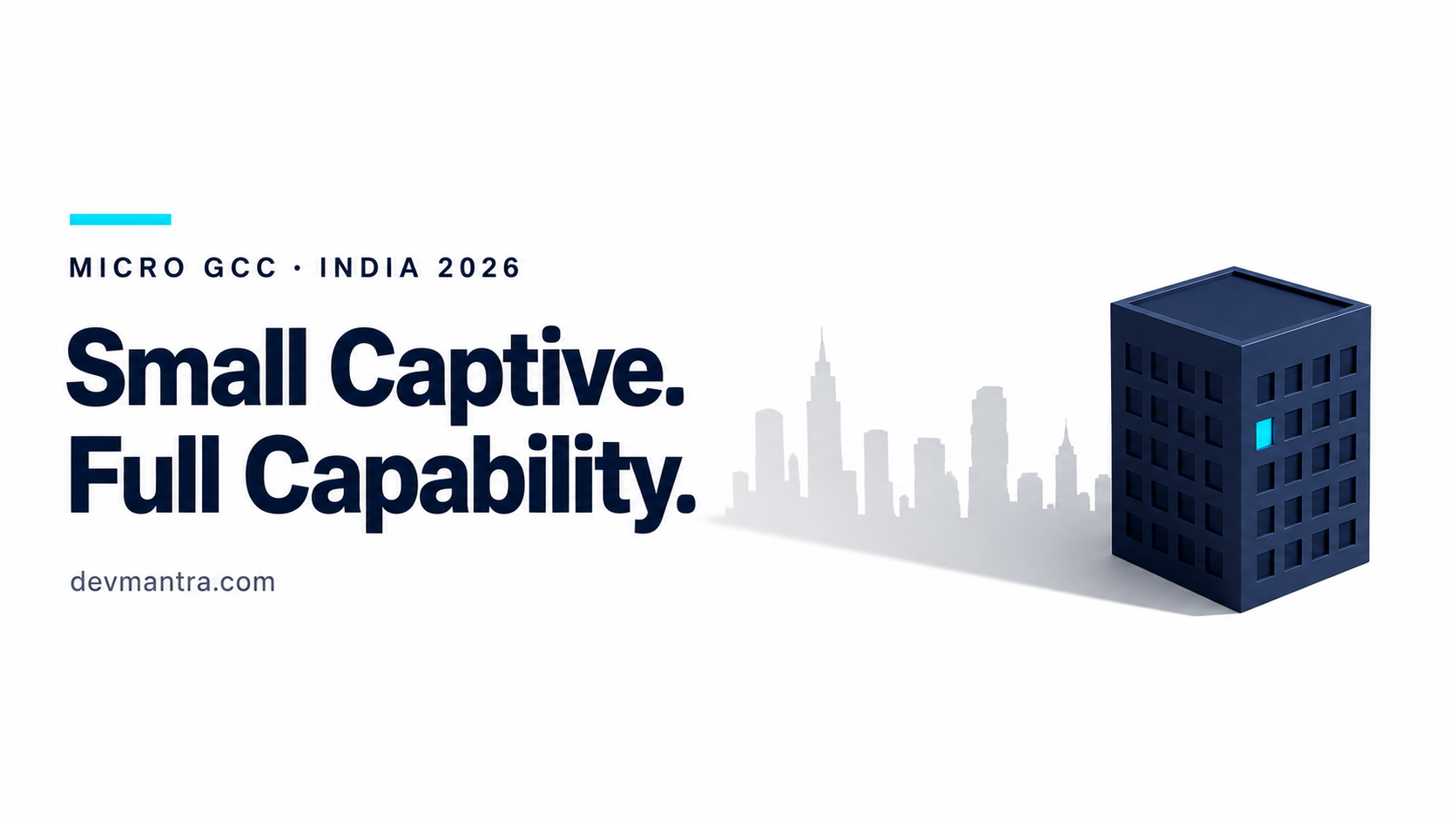
The Micro GCC changes that equation entirely. It is not a watered-down version of the classic captive - it is a structurally different entry point, faster and leaner, purpose-built for focused mandates. It is also the fastest-growing segment of new GCC formations in India in 2025 and 2026. If you are a mid-market company that has been waiting for the right moment to build in India, that moment is now.
What a Micro GCC Is, Precisely
A Micro GCC is a wholly-owned captive entity in India, typically 15–80 people, built around a narrow defined mandate and supported by GCC-as-a-Service infrastructure that handles the shared operational overhead.
Every word in that definition matters.
Wholly-owned captive means your IP is yours. The employees are direct hires. There is no vendor margin. No contract renewal. No institutional knowledge that disappears when a service agreement ends.
15–80 people means it operates at a scale that was previously uneconomical for a captive structure. The GCC-as-a-Service layer - shared legal entity management, payroll infrastructure, HR, IT security, compliance management - makes a 20-person team financially viable in a way it wasn't three years ago.
Narrow, defined mandate is what makes a Micro GCC work where a broad captive might not. Rather than trying to build a multi-function operation from Day 1, a Micro GCC owns one thing extremely well - AI and data engineering, audit support for a US CPA firm, fintech compliance operations, dedicated finance analytics - and builds from that base.
GCC-as-a-Service infrastructure is the enabling layer. Think of it as the shared services backbone that lets a 25-person team operate with the compliance architecture of a 250-person operation, without paying for 250-person overhead.
Why This Model Emerged Now
The Micro GCC didn't exist as a structured concept five years ago. Three things converged to make it viable.
GaaS infrastructure matured. The ecosystem of providers offering shared entity management, payroll, IT security, and compliance support for small captives reached the point where fixed infrastructure costs are distributed across dozens of clients. A 20-person team in Hyderabad no longer needs to build its own payroll system or compliance function from scratch. It plugs into infrastructure that already exists.
AI changed the talent math. A large GCC built in 2015 needed 500 people to achieve meaningful scale. An AI-first GCC built in 2026 needs 15 people with the right skills and clear ownership. The productivity per engineer has increased non-linearly. A focused team of 20 engineers owning a specific AI capability can outperform a diffuse team of 100 doing general support work.
Budget 2026 removed the tax complexity at small scale. The 15.5% safe harbour election - effective from Assessment Year 2026-27 - means a small captive entity can declare a clean profit margin and avoid transfer pricing scrutiny for 5 years. For a 20-person entity billing the parent for engineering services, this removes one of the historically significant compliance headaches of running a small captive.
State incentives now apply to small captives too. Karnataka's GCC Policy, Maharashtra's GCC framework, and UP's IT/ITeS incentives don't have a headcount floor. A 30-person captive in Hyderabad is eligible for the same rental reimbursements and R&D grants as a 3,000-person operation. That is leverage the mid-market has never had before.
Why the Micro GCC Is Capital Efficient
The cost comparison is where this model makes its case most clearly. Year 1 total cost for a 20-FTE Micro GCC across the major hubs:
| City | Total Year 1 | USD Equivalent |
|---|---|---|
| Hyderabad | ₹6–8 crore | $640K–850K |
| Bengaluru | ₹7–10 crore | $740K–1.05M |
| Pune | ₹5.5–7.5 crore | $580K–790K |
| Tier-2 (Kochi / Coimbatore) | ₹4–6 crore | $420K–630K |
Compare that to the cost of outsourcing the same function to a BPO vendor. A 20-person dedicated team from a mid-tier BPO provider typically runs ₹7–10 crore annually - with a 15–20% vendor margin built in, no IP ownership, and a contract that limits what the team can build.
- Year 1 cost: ₹6–8 crore
- IP ownership: full
- Vendor margin: zero
- Contract renewal risk: none
- Talent retention: direct management
- Breakeven vs BPO: Month 14–18
- Year 1 cost: ₹7–10 crore
- IP ownership: none
- Vendor margin: 15–20%
- Contract renewal risk: every 3–5 years
- Talent retention: via vendor
- Breakeven: never (ongoing margin)
The setup-cost picture sharpens the case further. A traditional BOT or DIY captive runs $500K–1.5M in upfront setup capex. A Micro GCC built through GaaS infrastructure comes in under $100K. Time to first hire drops from 12–16 weeks to 4–8 weeks.
The 5-year picture is even clearer. A 20-person captive operation competes cost-effectively with a BPO from roughly Month 18 onward, and builds an asset the BPO never will.
What Functions Work Best in a Micro GCC
Not every function belongs in a Micro GCC. The model works best where work is IP-creating, where continuity of team knowledge compounds over time, and where direct management produces better outcomes than vendor SLAs.
AI and data engineering. The most common Micro GCC mandate in 2025–26. A focused team of 15–20 engineers owning a specific model, data pipeline, or ML infrastructure. Full IP ownership from Day 1. No vendor in the middle when the model improves.
Audit support for US and UK CPA firms. Dedicated India teams handling working paper preparation, data reconciliation, and audit analytics. The institutional knowledge of client accounts compounds with the same team year after year. A 15-person dedicated team in Coimbatore or Kochi delivers at 25–35% of equivalent US cost, with retention rates significantly higher than shared BPO pools.
Financial operations and management accounting. Month-close support, management reporting, FP&A - for mid-market companies where the CFO wants a team that understands the business, not a shared service centre that rotates staff.
Fintech compliance operations. AML, KYC, regulatory reporting, and risk operations for financial services companies. High-IP, high-continuity work that should not sit with a vendor.
Focused product engineering squads. Feature teams, platform pods, embedded squads that own specific product areas end-to-end.
What doesn't work well in a Micro GCC: high-volume transactional processing (this is where BPO genuinely wins on scale), functions requiring physical presence in multiple locations, and work that has zero IP accumulation over time. Match the model to the nature of the work.
The Three Paths Into a Micro GCC
There is no single right way to build one. The approach depends on how much risk you can absorb upfront and how fast you need to be operational.
Path 1: EOR to Micro GCC Conversion
Recommended for first-time India entrants. Start with an Employer of Record provider - Wisemonk, Deel, or a similar platform - and hire 5–10 people to prove the model. Validate that the function works, that the talent is available, and that the operating model fits before committing to entity setup. At 15–20 people, convert to a captive Micro GCC with GaaS compliance support.
This path carries the lowest early-stage risk and the fastest route to learning. Timeline: 3–6 months EOR pilot, then 6–8 weeks to entity conversion. First hire in days.
Path 2: Direct Captive with GaaS Support
Register the entity directly. Use a GCC-as-a-Service provider for shared payroll, HR, and compliance infrastructure. Start hiring immediately. Best for companies that have India experience, have validated the talent hypothesis, and want to maximise IP ownership from the start.
Timeline: 8–12 weeks to first hire.
Path 3: BOT at Small Scale
A BOT provider builds the team and manages the entity for 12–18 months, then transfers. This path costs more in the operating period - BOT margin 10–25% - but reduces execution risk for first-time India operators who need the mandate to be proven before taking on the compliance overhead.
Timeline: 4–8 weeks to first hire.
The recommended scaling path for most mid-market companies: EOR pilot (3–6 months), Micro GCC captive at 15–20 FTE, scale to 40–60 FTE on the same mandate, evaluate expansion into a second function or full GCC at 80–100 FTE.
The Compliance Reality for Small Captives
Here is the most important thing to understand about running a Micro GCC: the compliance obligations do not scale down proportionally with headcount. A 20-person captive faces the same legal architecture as a 2,000-person one.
- FC-GPR filing with the RBI within 30 days of share allotment
- Annual transfer pricing documentation via Form 3CEB
- DPDP Data Fiduciary obligations effective May 2027
- Labour Code compliance under the new framework, effective November 2025
- Statutory audit, FEMA annual returns, and GST filing
Annual compliance cost for a 20-person Micro GCC: approximately ₹15–30 lakh, or $16K–32K. That is not a number to be surprised by. It is a number to plan for.
Two things help significantly at small scale. The 15.5% safe harbour election under Budget 2026 removes transfer pricing scrutiny for 5 years, eliminating the most complex and expensive annual compliance exercise for most small captives. Elect it from Year 1. And a GCC-focused advisory partner who handles the compliance calendar - FEMA filings, TP documentation, DPDP assessment, Labour Code compliance - removes the internal overhead of managing it yourself. For a 20-person team, this is not overhead that makes sense to build internally.
The Growth Journey: Month 1 to Month 36
A Micro GCC is not a static structure. The companies that get the most value from it treat it as a staging point, not a destination.
Months 1–3: Foundation
Entity setup (or EOR-to-entity conversion), first hires, compliance architecture, transfer pricing election, GaaS infrastructure activation. Primary goal: hire the founding cohort correctly. Your first 15 people define your employer brand in the local talent market for years.
Months 4–12: Mandate Execution
The team is working. DPDP compliance build starts. Governance rhythm established - monthly reporting to parent, quarterly steering committee. KPIs shift from headcount to output: what is the team actually delivering, and is it the strategic capability you set out to build?
Months 13–24: Evaluate and Decide
Is the mandate working? If yes: begin scaling within the function, or identify the second function to bring in. If attrition is low and the team has delivered, this is the moment to start building the employer brand actively - engineering blogs, open-source contributions, NASSCOM engagement.
Months 24–36: Scale or Stay
Some companies stay at 40–60 FTE focused on a single mandate and find it more valuable than a 200-person diffuse operation. Others use the Micro GCC as the proof point that enables the Board to approve a full-scale GCC. Both are valid outcomes. The Micro GCC gives you the data to make that decision with evidence rather than assumption.
The Micro GCC is not a watered-down captive. It is a structurally different entry point - wholly-owned, IP-keeping, compliance-handled - that operates at a scale that was previously uneconomical. Mid-market companies finally have the model they have been waiting for.
- A Micro GCC is a wholly-owned captive of 15–80 FTE on a narrow mandate - full IP, no vendor margin, no contract renewal risk
- Year 1 cost runs ₹4–10 crore depending on city, with Tier-2 hubs like Kochi and Coimbatore at the lower end
- Breakeven vs BPO arrives at Month 14–18, after which the captive cost advantage compounds every year
- Compliance does not scale down with headcount - plan for ₹15–30 lakh annual overhead and elect the 15.5% safe harbour from Year 1
- The lowest-risk path for first-time entrants: EOR pilot for 3–6 months, then convert to a Micro GCC at 15–20 FTE
How Dev Mantra Guides Micro GCC Setup
Dev Mantra Financial Services was designed for exactly this part of the market - companies serious enough about India to want a captive, but not large enough to absorb the overhead of a traditional GCC advisory engagement.
The firm's CA-led, compliance-first model means the entity gets structured correctly from Day 1: transfer pricing architecture before the first invoice is raised, FEMA compliance from the moment the first investment is made, DPDP readiness built in before enforcement arrives, and CFO-level advisory that grows with the entity.
For US CPA firms in particular, Dev Mantra's audit support model - a dedicated India team working exclusively on the firm's client work - is a Micro GCC in practice. The economics are compelling. The compliance is handled. The IP stays with the firm.
If you are evaluating whether a Micro GCC makes sense for your business, the conversation starts with Dev Mantra's GCC advisory team.
NASSCOM-Zinnov India GCC Landscape Report (Sep 2024); Finance Act 2026; MeitY DPDP Rules notification (Nov 2025); ANSR GCC Compensation Report 2025; Wisemonk GCC Setup Guide 2026; Karnataka GCC Policy 2024–29; Bootminds Tier-2 GCC Viability Report 2026.
How to Set Up a GCC in India in 2026 - costs, models, and the Micro GCC explained.
GCC vs Captive Center vs BPO - how this setup model compares to captive and BPO alternatives.