For two decades, "setting up in India" meant one of two things: hire a BPO vendor and hand them a process, or build a 500-person captive with a multimillion-dollar setup budget. A third path has emerged - and most companies evaluating India in 2026 don't know it exists yet.
This guide covers what a Global Capability Center actually delivers, why the model is maturing faster than predicted, the real cost numbers, the setup models available, and why the Micro GCC is becoming the entry point of choice for mid-market companies.
What a GCC Actually Is
A Global Capability Center is a wholly-owned subsidiary of a foreign company, staffed entirely with direct employees, delivering strategic work back to the parent. The entity sits on Indian soil, operates under Indian law, but works exclusively for - and is owned entirely by - the global parent.
That ownership structure is everything. With a third-party BPO, you get a service. With a GCC, you build an asset. IP compounds inside your own entity. Institutional knowledge stays with your people, not a vendor's. The strategic capabilities you build - AI, product engineering, financial analysis, risk operations - are yours to direct, evolve, and own for the next decade.
The classic image of a GCC is a 500–1,000 person tech park operation built by a Fortune 500. That image is accurate but increasingly incomplete.
90% of those centers are now multi-functional. Over 174 belong to Fortune 500 companies, housing 950,000+ professionals. The $70 billion in annual revenue this sector generates is projected to reach $99–105 billion by 2030. The more interesting story, though, isn't the scale at the top - it's what's happening in the middle.
Why 2026 Is a Different Entry Point
Three things have changed that make GCC setup more accessible, more tax-efficient, and more legally clear than at any point in the last decade.
Transfer pricing certainty, finally
Budget 2026 introduced a uniform 15.5% safe harbour margin for all Information Technology Services, raising the threshold from ₹300 crore to ₹2,000 crore. If your Indian entity operates at a 15.5% profit margin on transactions with the parent, the tax department accepts it without audit. Commercially, this means a decade of expensive TP litigation - the single biggest financial uncertainty in GCC operations - is largely behind us.
DPDP Rules are now live
India's Digital Personal Data Protection Rules were notified in November 2025, with full obligations enforced from May 2027. This isn't a risk to delay acting on; it's a compliance architecture to build now. GCCs that get this right at setup avoid the retrofitting cost later.
State-level competition for GCCs is real
Karnataka launched India's first dedicated GCC policy in 2024, offering 50% rental reimbursement for Tier-2 locations, R&D grants up to ₹50 crore, and a 45-day fast-track approval. Maharashtra, Telangana, UP, and Gujarat have followed with their own incentive frameworks. The states are competing for your entity - that is leverage you can use.
The Cost Reality
Too many companies build business cases on brochure estimates. Here are the actual Year 1 numbers for a 50-person captive WOS, by city:
- Bengaluru: ₹19–24 crore ($2.0–2.55M)
- Hyderabad: ₹16–20 crore ($1.7–2.1M)
- Pune: ₹14–17 crore ($1.5–1.8M)
- Ahmedabad / GIFT City: ₹12–15 crore ($1.3–1.6M)
Salary drives most of that spread. A blended 50-person engineering team in Bengaluru runs ₹14–16 crore in loaded CTC annually; in Hyderabad, ₹12–13 crore. Costs relatively consistent across cities include incorporation and regulatory filings (₹20–40 lakh), recruitment (₹0.5–0.8 crore), setup consulting (₹1.5–3.0 crore), and technology infrastructure (₹1.0–1.5 crore).
Two adjustments most models miss. One: USD/INR was ₹94.9 in May 2026 - models built in 2023 using ₹83.5 understate costs by roughly 14% before a single hire. Two: the new Labour Codes (effective November 2025) mandate basic pay must be at least 50% of CTC. Add EPF, gratuity provisioning, and EDLI, and your actual employer cost runs 1.10–1.15x the gross CTC in any offer letter.
The 5-year picture is where the numbers become compelling. A 100-person captive GCC in India costs roughly $35–45M over five years. The equivalent US operation: $40–60M.
The Model That's Changing the Conversation
The old binary - full captive for the Fortune 500, BPO for everyone else - has broken down. The Micro GCC is a wholly-owned captive of 15–80 people, with a narrow mandate, accelerated setup, and a cost structure that finally works for mid-market companies priced out of the classic captive model.
Why the Micro GCC Works
The concept exists because three things converged. First, GCC-as-a-Service providers now offer shared infrastructure - legal entity management, payroll, IT security, HR - that lets a 30-person team operate with the governance of a 300-person operation without paying for all of it upfront. Second, India's engineering talent is concentrated enough that a focused 20-person AI or data team can genuinely move product strategy, not just support it. Third, companies building AI-first operations in 2025 and 2026 don't need large teams - they need the right 15 people, with full ownership of the capability, not a vendor relationship that limits what they can build.
- $500K–1.5M setup capex
- 12–16 weeks to first hire
- 10–25% operating margin to provider
- IP transfer at 18–36 months
- Under $100K setup capex
- 4–8 weeks to first hire
- Full IP ownership from Day 1
- No vendor margin, no renewal risk
Total Year 1 operating cost for a 20-person Micro GCC in Hyderabad runs approximately ₹6–8 crore ($640K–850K). The right fit is the mid-market technology company that has been outsourcing a specific function and is ready to own it; the US CPA firm that wants a dedicated India team of 15–25 accountants on its client work; the PE-backed business that needs a focused finance and analytics center before a liquidity event.
The Micro GCC is not a compromise. It is a focused entry point that many companies grow into a full GCC over 24–36 months - without the upfront capital commitment or the multi-year vendor relationship.
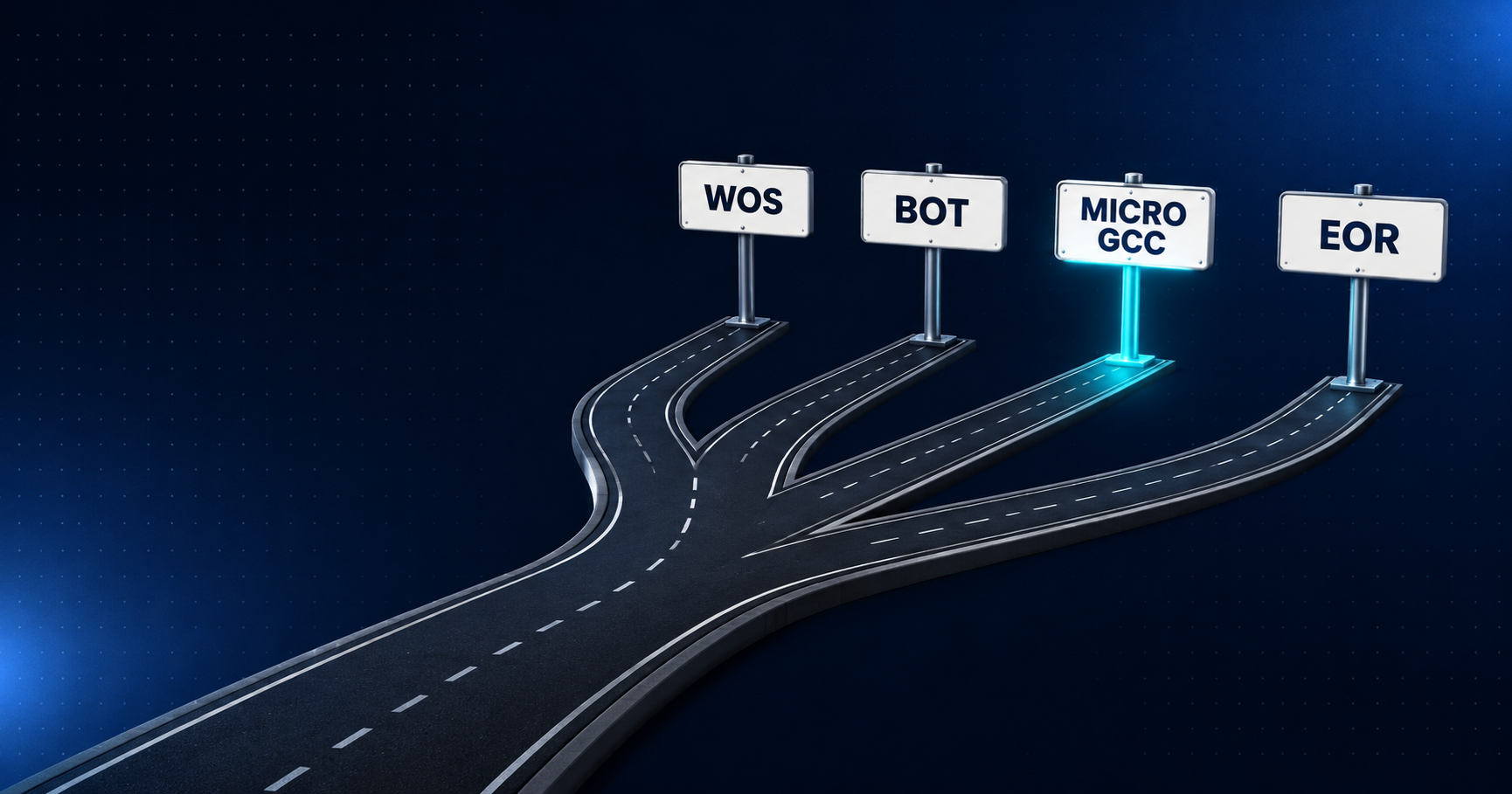
The Four Setup Models
Captive / Wholly-Owned Subsidiary
Best for 200+ planned headcount, a clear multi-year mandate, and an India leadership team already identified. Timeline to first hire: 12–16 weeks. Setup capex: $500K–1.5M. Full control, full responsibility - IP yours from Day 1, compliance yours too.
Build-Operate-Transfer (BOT)
Best for mid-market entry at 50–500 FTE, first-time India operators, and regulated sectors. Timeline: 6–10 weeks. Operating margin to BOT provider: 10–25%. Partner builds and runs the center for 18–36 months, then transfers entity, team, and IP. Used by 35–40% of new GCCs. Providers include ANSR, Inductus, Aeries Technology, and Hexaware.
Micro GCC / GCC-as-a-Service
Best for 15–80 FTE, capital-efficient entry, and a focused mandate. Timeline: 4–8 weeks. The fastest-growing segment of new GCC formations in India. Cost runs 1.8–2.0x CTC, but shared infrastructure offsets the premium at small headcount.
Employer of Record (EOR)
Best for pilots under 25 people. Days to first hire. Works until headcount and Permanent Establishment risk make conversion to captive necessary. Providers include Wisemonk, Deel, and Rippling.
What Services You Need, and When
At setup (Months 1–4): entity incorporation, FEMA registration, RBI FC-GPR filing within 30 days of share allotment, GST registration, transfer pricing framework design, initial statutory compliance setup, and lease structuring.
In the first operating year: payroll compliance under the new Labour Codes, transfer pricing documentation (Form 3CEB), DPDP Data Fiduciary assessment, ongoing FEMA filings, and statutory and tax audit.
Ongoing (Year 2+): annual TP refresh, safe harbour election under Budget 2026 provisions, DPDP compliance build-out ahead of May 2027 enforcement, state incentive applications, and CFO advisory as the entity scales.
A missed FC-GPR filing can scale to 3x the investment amount under FEMA compounding. TP documentation failure carries a penalty of 2% of transaction value. DPDP violations cap at ₹250 crore. Getting the compliance architecture right from Month 1 costs a fraction of fixing it in Year 3.
The City Changes More Than the Rent
- Bengaluru - 880–950 GCCs, 50% of India's AI talent, 18–22% attrition. Right for deep product engineering and AI/ML mandates.
- Hyderabad - Fastest-growing hub, 14–16% attrition, rent 20–30% cheaper than Bengaluru. Right for cloud operations, platform engineering, BFSI tech.
- Chennai - Lowest attrition of any Tier-1 city at 12–14%. Right for BFSI operations, automotive engineering, healthcare.
- Tier-2 cities (Coimbatore, Kochi, Indore, Jaipur) - 40–60% lower rent, 7–11% attrition, 21% YoY hiring growth. Right for focused finance, audit, and data teams where stability matters more than talent density.
For a Micro GCC specifically, Hyderabad or a Tier-2 city often delivers better economics and lower turnover than Bengaluru - particularly for finance, audit, or data work rather than frontier AI development.
How Dev Mantra Guides You Through It
Dev Mantra Financial Services has been advising companies on India market entry, GCC setup, and financial compliance from Bengaluru since 2008. Over ₹5,000 crore in transactions managed. 20+ years of operational history with Indian and global clients.
Most GCC advisory firms operate at one of two ends: large-enterprise BOT providers who need 500-person mandates to justify their fees, or offshore HR platforms optimised for EOR. The mid-market - companies building their first India captive at 20–150 FTE - is where the gap sits.
Dev Mantra fills that gap with CA-led, compliance-first advisory across the full lifecycle: entity setup and FEMA registration, transfer pricing from Day 1, DPDP compliance architecture, ongoing statutory filings, and CFO-level strategic support as the entity scales.
- A GCC is an asset you own - not a service you buy. IP, capability, and institutional knowledge compound inside your entity.
- Budget 2026's 15.5% safe harbour and the live DPDP Rules have removed the two largest legal uncertainties from GCC setup.
- A Micro GCC of 15–80 people now delivers the ownership of a captive at a fraction of the traditional setup cost - and starts hiring in 4–8 weeks.
- Year 1 cost for a 50-person team ranges from ₹12 crore in Ahmedabad to ₹24 crore in Bengaluru; city choice changes the business case more than most models assume.
- Build compliance architecture at Month 1, not Year 3 - FEMA, TP, and DPDP penalties scale with revenue, not effort.
The question for 2026 isn't whether India belongs in your operating footprint. It is which version of India fits the company you are building - and whether you start with the model that lets you own the capability from Day 1, or the one that asks you to wait three years for transfer.
GCC (Global Capability Centers) - for the end-to-end setup, compliance, and CFO-level support once you've picked a model.
GCC vs Captive Center vs BPO - how to choose the right operating model before you commit to a structure.
Micro GCC India 2026 - setup cost, paths, and timeline for the 15ÔÇô80 person model this guide references.