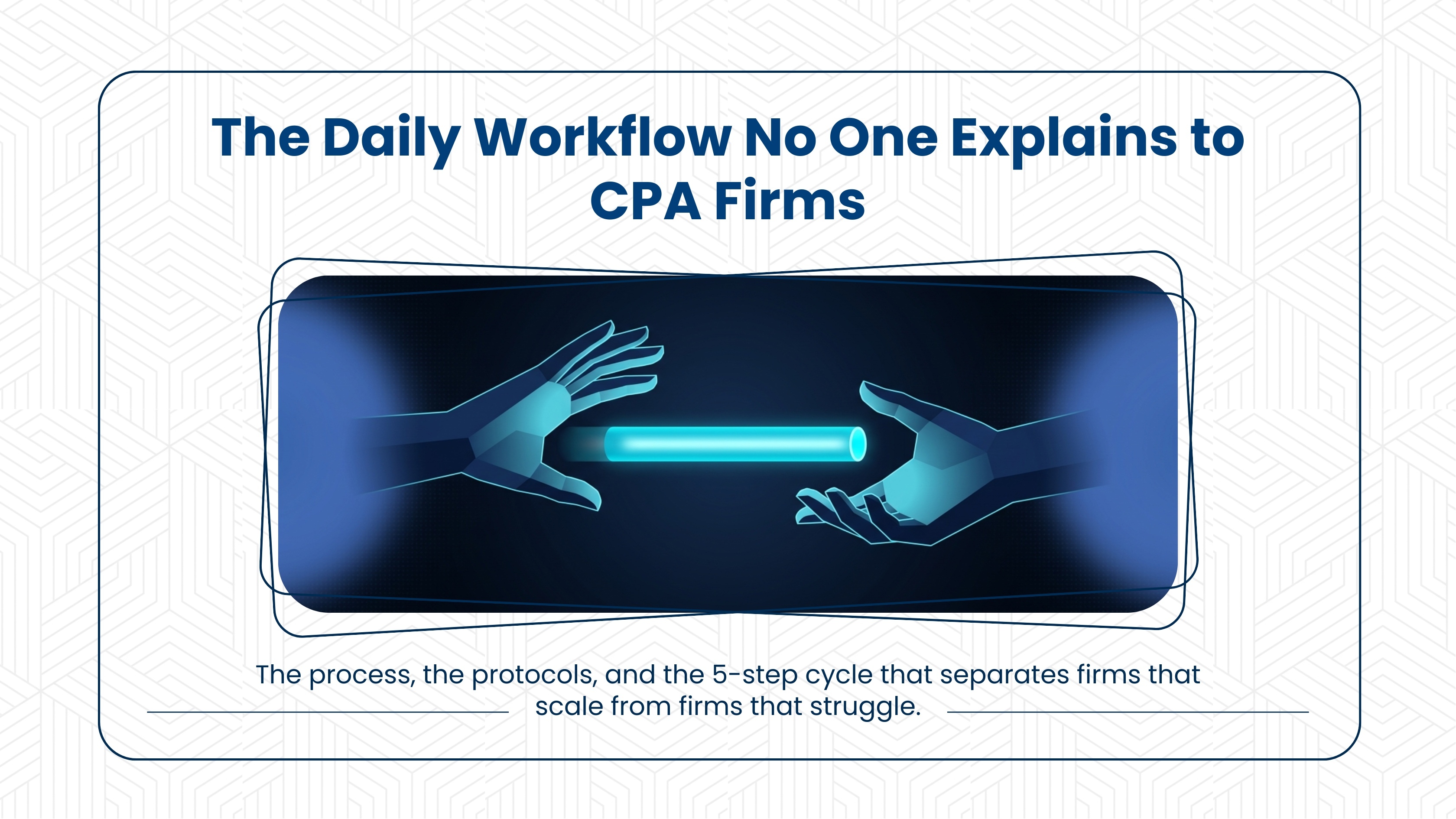
The modern CPA firm runs on a 24-hour clock — and the firms scaling fastest have figured out why. A well-designed US–India accounting workflow does not just move work across borders; it restructures turnaround time, capacity, and client experience. But the firms that succeed treat it as an operational system, not outsourcing.
The Core Concept: A 24-Hour Accounting Engine
At its core, a US–India accounting team workflow is built around one idea: time zone leverage. When the US team ends its workday, the India team begins. Instead of work sitting idle for 12–14 hours, it moves forward continuously.
By the time the US team logs back in the next morning, significant progress — or even completion — has already been achieved. The model fundamentally changes turnaround time, team productivity, and client experience.
Step 1: The End-of-Day US Handoff
The workflow begins in the United States at the end of the business day, typically around 6:00–6:30 PM EST. This is one of the most critical steps in the entire process.
US team members finalise workpapers, update client notes, and assign tasks clearly within their practice management system. Every instruction must be explicit — what needs to be done, how it should be handled, and any client-specific nuances.
A poor handoff disrupts the entire next cycle. Vague task notes lead to rework, missed nuances, and wasted India production hours — eroding the time zone advantage the model is built on.
Step 2: India Team Kickoff and Alignment
The India team typically starts its day at around 9:00 AM IST with a structured team standup. Members review assigned tasks, clarify expectations, and identify dependencies or blockers before production begins.
Unlike traditional outsourcing models, this is not a passive execution layer. High-performing India teams operate with ownership, accountability, and a clear understanding of deliverables.
Step 3: Core Production Hours in India
From approximately 9:30 AM to 6:00 PM IST, the India team enters its core production window. This is where the bulk of accounting work is completed.
The work spans bookkeeping, reconciliations, tax return preparation (1040s, 1065s, 1120s), audit workpapers, and financial statement preparation. Because this happens while the US team is offline, it represents a powerful productivity gain — work is already progressing, often nearing completion, before the US team logs in again.
Step 4: Morning Delivery Back to the US
By 6:30 PM IST (approximately 8:00 AM EST), the India team completes its work and prepares for handoff back. Deliverables typically include completed or partially completed returns, updated accounting records, and documented workpapers ready for review.
Any notes, assumptions, or open questions are clearly documented to ensure continuity. When the US team begins its day, they are not starting from scratch — they are stepping into a workflow that has already advanced significantly.
Step 5: The Overlap Window for Collaboration
The only real-time collaboration window between the US and India teams occurs during the early US morning, typically between 8:00 AM and 9:30 AM EST. This overlap is used for quick feedback, clarifications, and review discussions.
Instead of long meetings, efficient teams rely on structured communication tools such as Slack, Microsoft Teams, Loom recordings, and practice management platforms. The short window ensures alignment without disrupting the asynchronous nature of the workflow.
Why This Workflow Works
A well-executed US–India accounting team workflow delivers four compounding advantages:
- Continuous productivity, with work progressing around the clock instead of pausing at the end of each US shift
- Significantly reduced turnaround times, allowing firms to serve clients faster without increasing domestic workloads
- US-based professionals freed to focus on higher-value activities such as client advisory and final reviews, rather than routine production
- A scalable growth model that taps India's deep accounting talent pool without the constraints of local hiring limits
Why Most Firms Struggle With This Model
Despite its advantages, many firms fail to implement the model effectively. The most common issues are not related to talent or cost — they are related to process.
- Vague task instructions
- No standardised SOPs
- Unclear quality controls
- Reactive, ad-hoc communication
- India team treated as execution-only
- Detailed handoff templates
- SOPs for every service line
- Defined QA and review frameworks
- Async plus overlap communication protocols
- India team owns deliverables end-to-end
The Foundation: SOPs, Handoffs, and QA Systems
The most successful firms build their US–India accounting team workflow on three foundational elements. They implement detailed standard operating procedures that define exactly how work should be performed. They establish structured handoff protocols to ensure seamless transitions between teams. They design robust quality assurance frameworks that maintain accuracy and consistency.
Together, these elements turn the workflow from a reactive process into a predictable, high-performance system.
A US–India accounting team workflow is not a cost-saving strategy — it is a growth engine. The difference between firms that succeed and firms that fail is not the idea, but the execution.
Before scaling, build four assets: a daily handoff template, defined SOPs for each service line, a documented async-plus-overlap communication protocol, and a QA review framework. These four assets do more for outcomes than headcount ever will.
- The US–India model works because of time zone structure, not labour arbitrage — treat it as an operational system, not outsourcing
- Every cycle hinges on the end-of-day US handoff; vague instructions destroy the entire next-day output
- The 8:00–9:30 AM EST overlap is the only real-time window — protect it for clarifications, not status meetings
- SOPs, structured handoffs, and a defined QA framework are the three non-negotiables for a high-performance cross-border team
- The India team should own deliverables, not just execute tasks — accountability is what separates this model from traditional outsourcing
The firms that win the next decade will not be the ones with the largest US teams — they will be the ones with the most thoughtfully engineered workflows. If your cross-border setup still feels like outsourcing, the question is not whether to fix it, but how soon.
Finance & Accounts Compliance Outsourcing - for teams ready to move from ad-hoc cross-border support to a structured, SOP-driven accounting function.