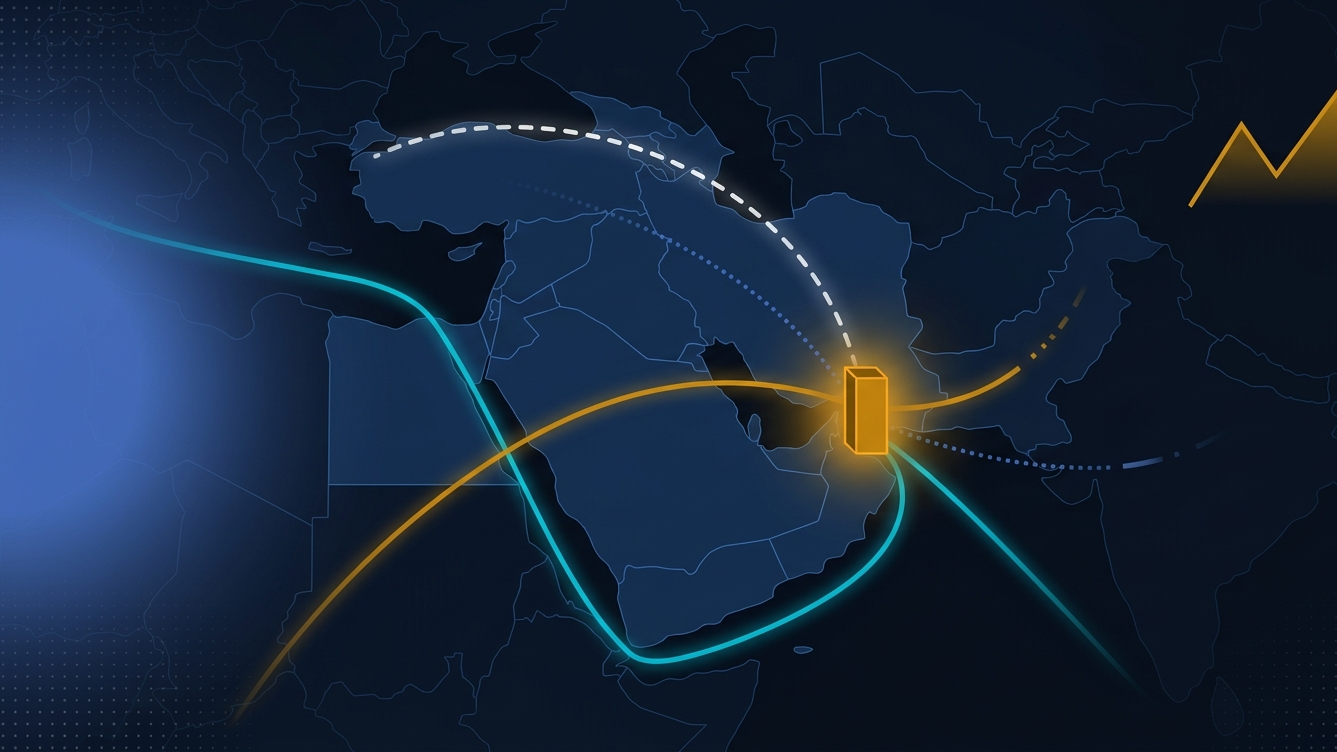
The escalating conflict involving the United States, Iran, and the Gulf states has moved well beyond regional geopolitics. As of March 2026, direct strikes on energy infrastructure and the effective closure of major maritime chokepoints have made it a systemic global financial shock — one that touches energy, trade, aviation, capital flows, and the cost of capital itself.
This is not just a war. It is a contest over the arteries of global movement: energy corridors, shipping lanes, aviation routes, and capital itself.
Energy: The First Transmission Channel
The most immediate financial impact is on energy. Oil has surged close to $110 per barrel on supply fears, and up to 20% of global oil flows through the Strait of Hormuz — now heavily disrupted. LNG production disruptions threaten roughly a fifth of global supply.
This is a classic inflationary shock — higher transport costs feed into higher goods prices, which then drive global inflation and tighter financial conditions. From a markets perspective, energy has become both a macro hedge and a policy constraint.
Trade and Aviation: A Mobility Breakdown
Tanker traffic through the Strait has nearly halted, with vessels avoiding the region. The result is a mobility breakdown that touches commodities, manufacturing supply chains, and global trade liquidity at the same time.
Aviation is faring no better. Airspace closures across the Middle East are compressing airline margins and hitting tourism-dependent economies like the UAE. Industries with thin chokepoint redundancy — fertilizers, industrial gases, automotive components — are seeing slower goods movement and rising inventory costs.
Capital: Risk-Off, Cost Up
Capital markets are in a clear risk-off regime. Equities are falling, volatility is rising, and borrowing costs are higher across the board. Money is shifting toward safe havens — USD, gold, treasuries — and emerging markets are facing capital outflows as risk premiums widen.
The UAE captures the contradiction sharply. Higher oil revenues are positive, but tourism and aviation declines, plus elevated infrastructure risk, undercut the gain. Volatility has replaced stability in what was, until recently, one of the world's most reliable trade and finance hubs.
Economists warn that in some scenarios, this conflict could reduce global GDP growth and add over 1 percentage point to inflation. Low growth combined with high inflation is the worst possible combination for markets — it creates stagflation risk.
The Structural Story: A Tax on Motion
The deeper financial story is structural. This conflict accelerates a shift already underway — from efficient global movement, just-in-time supply chains, and open trade routes, toward fragmented trade blocs, strategic reserves, and redundant supply chains.
In financial terms, that means a higher cost of capital, lower efficiency of global allocation, and a permanent risk premium on mobility. War has effectively become a tax on motion:
- Moving oil is more expensive
- Moving goods is slower
- Moving people is restricted
- Moving capital is more cautious
Translated into market language: inflationary pressure, lower growth, higher volatility, and a structural repricing of risk.
The world is not just witnessing a geopolitical conflict. It is witnessing the repricing of globalization itself — and the cost of motion is now permanently higher.
- The conflict is no longer regional — it is a systemic financial shock transmitted through energy, trade, aviation, and capital
- Oil near $110 and LNG disruption are creating a textbook inflationary shock with stagflation risk
- Capital is rotating to USD, gold, and treasuries, with widening risk premiums hitting emerging markets
- The structural shift is from efficiency to redundancy — higher cost of capital is now a permanent feature, not a cyclical one
- Boards and CFOs should price in mobility risk explicitly — supply chains, FX exposure, and capital plans need recalibration
The question for global businesses is no longer whether globalization is being repriced — it is whether your capital allocation, supply chain design, and treasury strategy reflect the new price. Firms that adjust early will absorb the shock; those that wait will pay it twice.
M&A advisory India — repricing geopolitical risk into deal valuations and restructuring cross-border transactions.
Deal structuring and due diligence — full due diligence before committing to a cross-border transaction in a volatile environment.
Strengthening Corporate Governance in a Global Economy — how to build a board-level governance framework that absorbs geopolitical and operational shocks.