When a foreign company evaluates India, the opportunity is usually obvious — a vast consumer base, a credible manufacturing and sourcing hub, and a regional operating base for global firms. But before any of that can happen, one foundational question must be answered: what is the right legal structure to enter India? This is where many companies get it wrong.
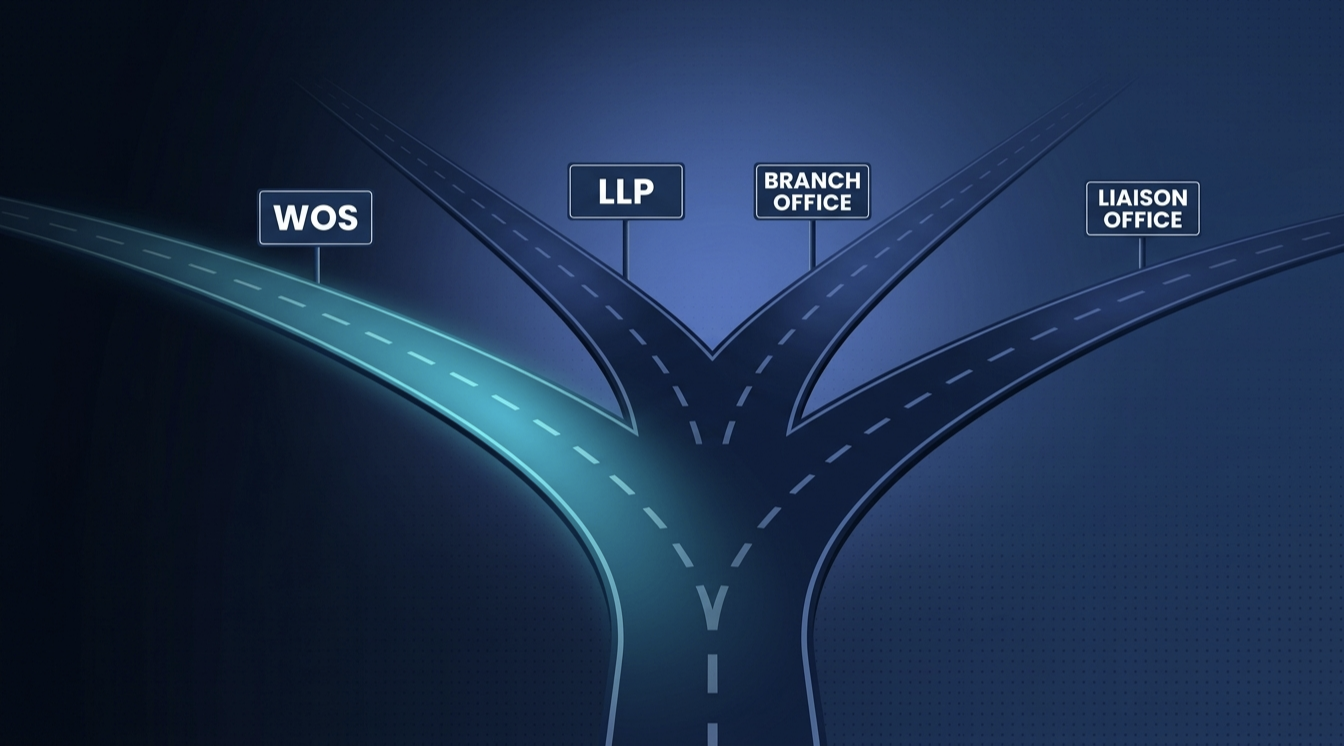
Choosing between a Wholly Owned Subsidiary, LLP, Branch Office, or Liaison Office is not merely a registration decision. It affects your ability to sell, manufacture, hire, invest, acquire assets, repatriate profits, and scale efficiently. The right answer depends less on speed and more on strategy.
Start With the Business Objective, Not the Form
Before selecting a structure, every foreign company should answer five questions:
- Do we want to generate revenue in India, or only maintain a representative presence?
- Are we entering India to sell, manufacture, source, or simply explore the market?
- Do we want to acquire real assets — land, plant, machinery, warehousing, office premises?
- Are we looking to access Government of India incentives, state subsidies, or production-linked schemes?
- Is India a long-term operating base or a short-term test?
The structure should follow the business model, not the other way around.
Wholly Owned Subsidiary: The Default for Serious India Plays
For most serious India entry plans, a Wholly Owned Subsidiary (WOS) is the most robust option. A WOS is a separate Indian legal entity owned by the foreign parent, and it is the preferred route where the company wants to sell in India, hire employees, sign customer and vendor contracts, manufacture locally, acquire operating assets, and build a long-term presence.
This becomes especially relevant where India is not just a sales destination, but part of a global manufacturing or supply chain strategy. A WOS is also the most practical structure for establishing a factory, acquiring fixed assets, participating in incentive-linked projects, or creating long-term enterprise value.
From a commercial standpoint, a WOS gives greater credibility with banks, customers, vendors, regulators, and investors.
LLP: Useful in Niches, Not the Default Answer
An LLP can look attractive because it offers limited liability with relatively flexible internal management. However, many businesses overlook whether the LLP route fits their actual expansion plan.
If the objective is serious scale, institutional investment, manufacturing footprint, equity infusion, or future strategic transactions, an LLP is rarely the cleanest vehicle. It works in select business models, but it is not automatically the best answer for every foreign entrant.
Branch and Liaison Office: Limited by Design
A Branch Office is an extension of the foreign parent, not a separate legal entity. It can work where the foreign company wants an India presence for specific permitted activities without a full local subsidiary, but it is generally limited in operational and strategic scope.
A Liaison Office is suitable only where the company wants a non-commercial representative presence — useful for market study, relationship building, and coordination. The critical limitation: a Liaison Office cannot undertake revenue-generating business activities in India. That makes it unsuitable for any company planning to sell, manufacture, contract, invoice, or operate commercially.
- Selling, manufacturing, or contracting in India
- Hiring local employees and signing vendor contracts
- Acquiring land, plant, machinery, or warehousing
- Accessing PLI or state-level incentives
- Building long-term enterprise value
- LLP — operational flexibility where the model permits it
- Branch — controlled extension of the parent for permitted activities
- Liaison — non-commercial market study and relationship building
- None of the above support full commercial scale-up
- Switching costs later are high — choose carefully now
The India entry decision is no longer about opening an office. It is about entering one of the world's largest consumer markets, building manufacturing capability, and creating durable operating value — which is why structure should be approached as a strategic exercise, not a filing exercise.
Map your three-year India plan first — revenue, hiring, asset acquisition, incentive participation. Choose the structure that supports the most ambitious version of that plan, not the most cautious one. Restructuring later is expensive and slows momentum.
- Structure follows strategy — pick the form that supports your three-year India plan, not the easiest one to file
- A WOS is the default for any company that wants to sell, manufacture, hire, or hold assets in India
- An LLP can fit niche models but is rarely the right vehicle for institutional capital or large-scale operations
- A Liaison Office cannot generate revenue — useful only for market study and coordination
- The wrong structure does not just slow entry; it caps how well you can grow once you are in
The right structure does not just help you enter India — it determines how well you can scale once you are here. Foreign companies that treat structuring as a strategic exercise unlock incentives, credibility, and growth headroom that filing-led entrants quietly leave on the table.
Company formation India — end-to-end entity registration, regulatory filings, and banking setup for foreign entrants.
M&A transaction support India — already in India and considering an acquisition? Full transaction advisory available.
India–China Relations in 2026: A Cautious Reset — the geopolitical forces accelerating the shift of multinational operations from China to India.